Press-On Nail Basics
What Are Press-On Nails? A Simple Guide for Beginners
Press-on nails are pre-shaped artificial nails that attach over your natural nails using nail glue, adhesive tabs, or a built-in adhesive layer. They arrive with the shape, length, color, and design already finished, so you can create a complete manicure without building an extension or waiting for polish to dry.
They can be short and natural-looking or long and highly decorated. What all press-ons have in common is that each nail is made in advance, fitted over the natural nail plate, and secured with adhesive.
This guide explains the meaning of press-on nails, what they are made of, how they attach, what usually comes in a kit, and how they differ from other artificial nail products.
For a broader look at choosing, applying, wearing, and caring for different types of sets, explore our complete guide to press-on nails.
1. What Are Press-On Nails?
Press-on nails are ready-made, full-cover artificial nails designed to sit over the visible surface of the natural nail. Instead of sculpting acrylic or gel directly on the finger, the wearer selects a pre-shaped nail, applies the recommended adhesive, aligns it near the cuticle, and presses it into place. A close fit helps the artificial nail sit more comfortably and make fuller contact with the natural nail. Learn how to choose the correct press-on nail size before applying your first set.
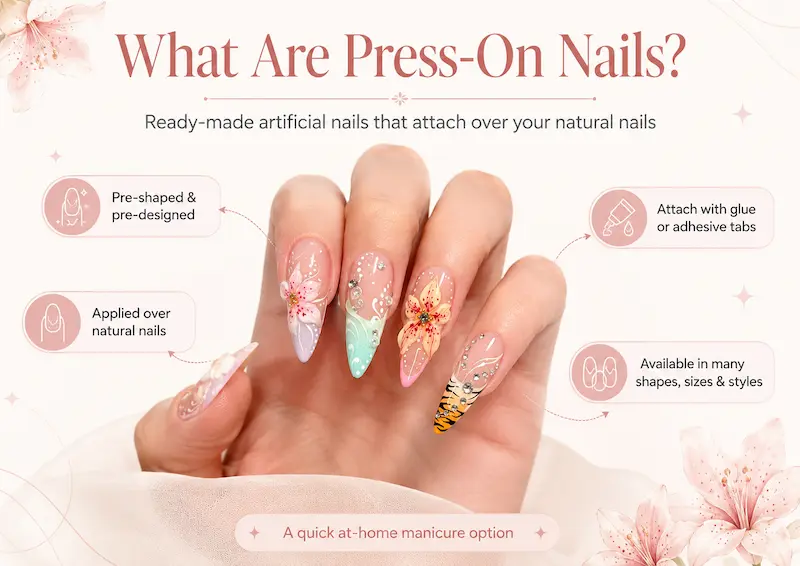
Press-on nails are finished artificial nails that attach over natural nails with glue, adhesive tabs, or pre-applied adhesive.
A press-on nail usually has three defining features:
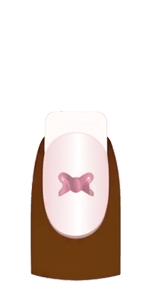
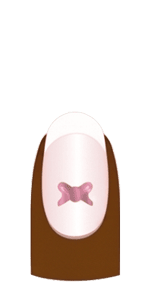
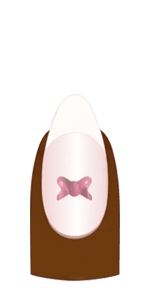
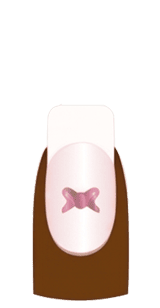
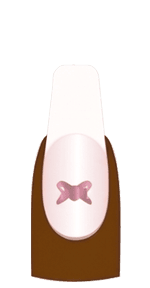
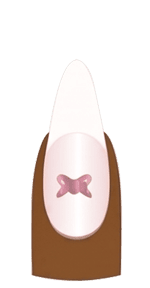
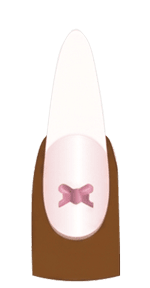
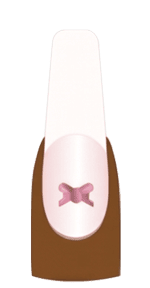
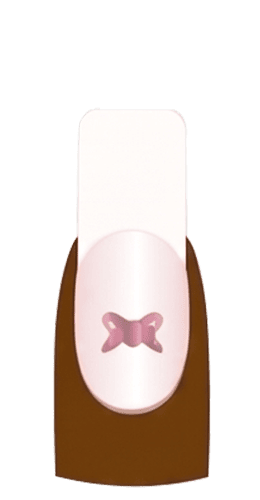
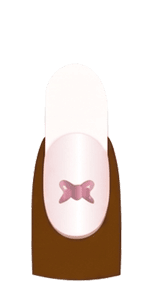
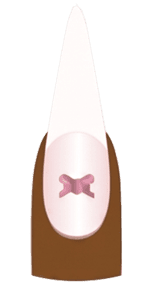
- It is pre-shaped. The length and silhouette-such as round, almond, square, coffin, or stiletto-already exist before application.
- It covers most or all of the natural nail plate, rather than only extending the free edge.
- It uses an adhesive system instead of being sculpted directly onto the finger.
The term “press-on” describes the final action of application: after the nail is aligned, it is pressed firmly so the adhesive can contact both surfaces. It does not mean every set already has glue attached. Some sets require liquid nail glue, some use separate adhesive tabs, and others come pre-glued.
Are Press-On Nails the Same as Fake Nails?
Press-ons are a type of fake or artificial nail, but “fake nails” is a broader informal term. It may also refer to acrylic extensions, gel extensions, sculpted enhancements, or other products placed over natural nails.
All press-on nails are artificial nails, but not all artificial nails are press-ons.
“Glue-on nails” usually means press-ons attached with liquid glue. “Stick-on” or “pre-glued nails” usually refers to press-ons with tabs or a built-in adhesive layer. Because product names are not completely standardized, the attachment instructions are more useful than the marketing label.
2. What Are Press-On Nails Made Of?
Most press-on nails use a molded synthetic plastic or resin-based nail base. The exact material varies by manufacturer, so it is more accurate to describe the category generally than to claim that every press-on uses one identical plastic or acrylic formula.
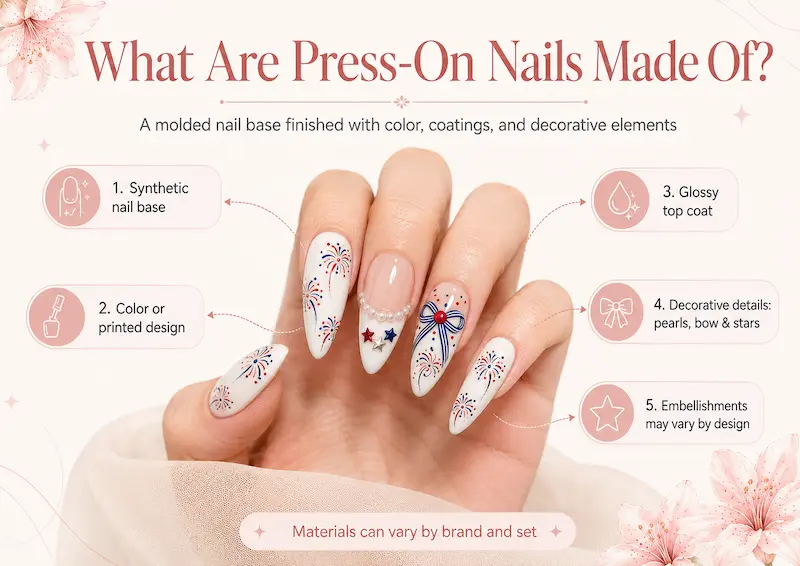
The finished nail can contain several components:
- A molded full-cover nail base
- Color, printed artwork, regular polish, or gel-based decoration
- A clear protective top coat
- Optional glitter, chrome powder, rhinestones, pearls, charms, or sculpted 3D art
The nail base determines the shape, width, curve, thickness, and flexibility. Surface decoration determines the final look. A simple solid-color set and a handmade floral set may use a similar base while feeling very different because one has a flat finish and the other has raised embellishments.
Press-ons are also different from traditional salon acrylic nails. Acrylic extensions are normally built by combining liquid monomer and polymer powder on the nail or a form. Press-ons are manufactured in advance and attached as completed pieces, even when their base contains acrylic-related polymers or other synthetic resins.
3. How Do Press-On Nails Attach to Natural Nails?
Press-on nails stay in place through an adhesive layer between the artificial nail and the natural nail plate. A close fit, clean surface, correct alignment, and firm pressure help that adhesive create better contact.
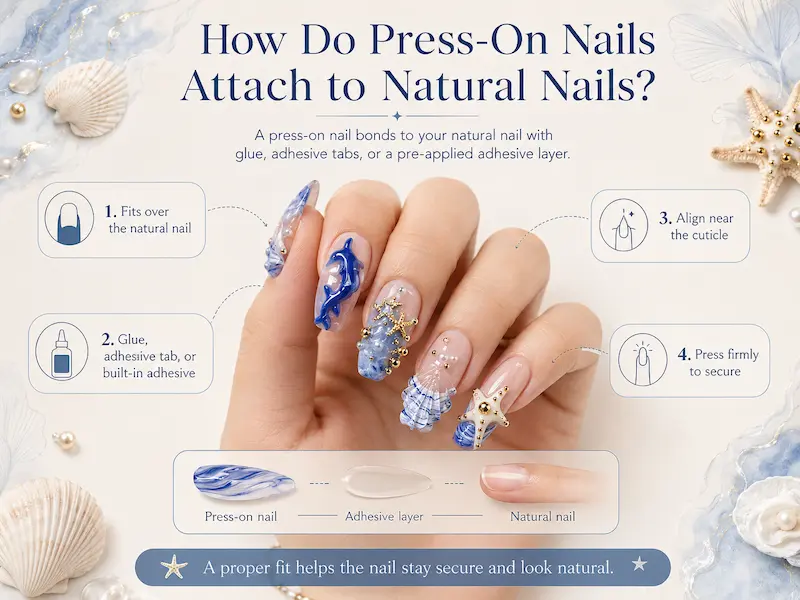
3.1. Nail Glue
Liquid nail glue generally creates the firmest bond and is commonly chosen for longer intended wear. The glue may be applied to the natural nail, the underside of the press-on, or both, depending on the product instructions. More glue is not necessarily better: excess can spread onto the skin, create an uneven layer, and make removal harder.
3.2. Adhesive Tabs
Adhesive tabs are thin, double-sided pieces placed between the natural nail and the press-on. They are often used for shorter wear, events, easier removal, and sets the wearer hopes to reuse. Tabs may feel slightly cushioned and can fill very small differences in curvature, but they cannot correct a press-on that is clearly the wrong size or shape.
Wear time and removal can vary between adhesive formulas, so it is worth understanding what to consider when choosing the right nail glue.
3.3. Pre-Applied Adhesive
Pre-glued or self-adhesive nails already have a sticky layer on the underside. The wearer removes the protective backing, aligns the nail, and presses it down. This is the simplest system, but the strength and expected wear time depend on the specific product.
| Attachment method | Best suited to | Main trade-off |
|---|---|---|
| Nail glue | Firmer attachment and longer intended wear | More residue and more careful removal |
| Adhesive tabs | Short wear, events, easier removal, possible reuse | Usually less resistant to water and impact |
| Pre-applied adhesive | Fast, beginner-friendly application | Bond strength cannot be adjusted |
Whichever system is used, the press-on should sit on the nail plate rather than the surrounding skin. A nail that pinches, causes persistent pressure, or leaves large gaps is likely a sizing or curvature problem-not something that should be fixed by adding more adhesive.
The exact process depends on whether the set uses glue, tabs, or built-in adhesive. Follow our step-by-step guide on how to apply press-on nails correctly for detailed preparation and application instructions.
4. What Comes in a Press-On Nail Kit?
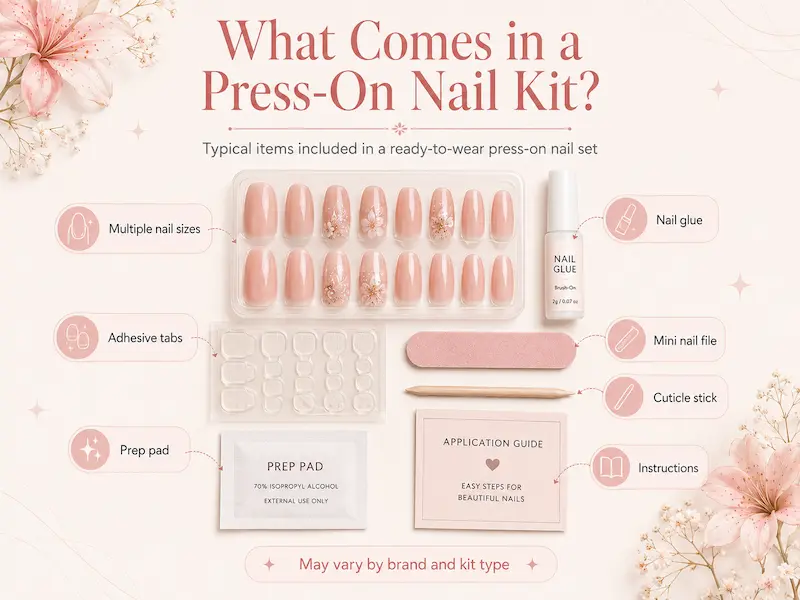
Kit contents differ by brand and attachment system, but a typical set may include:
- Press-on nails in multiple sizes
- Nail glue, adhesive tabs, or pre-applied adhesive
- A mini nail file or buffer
- A manicure or cuticle stick
- An alcohol prep pad
- Application and removal instructions
Ready-to-wear kits usually contain more than ten nails because nail-bed widths differ between people and between fingers. The extra pieces allow the wearer to choose a closer size for each nail. Custom-sized sets may contain only ten finished nails because the sizes were selected before production.
Why Fit Matters
A suitable press-on should cover the natural nail from sidewall to sidewall without resting on the skin. If you are between two sizes, a slightly larger nail can sometimes be refined carefully along the side edge. A nail that is too narrow cannot be made wider and may leave gaps or lift early.
Before buying, check whether the kit includes adhesive, the number of sizes provided, the nail length and shape, and whether the set is intended for reuse. Do not assume every product photo shows everything included in the package.
5. What Types of Press-On Nails Are Available?
Press-on nails can be classified by adhesive method, length, shape, finish, and sizing format. These categories help describe the product, but the best choice still depends on fit, intended wear, and daily activities.
| Category | Common options |
|---|---|
| Adhesive | Glue-on, adhesive-tab, pre-glued/self-adhesive |
| Length | Extra short, short, medium, long, extra long |
| Shape | Round, oval, almond, square, squoval, coffin, stiletto |
| Finish | Solid color, French tip, chrome, cat-eye, glitter, printed, hand-painted, 3D embellished |
| Sizing | Standard ready-to-wear, made-to-size, fully custom |
Short, round, oval, square, squoval, and almond styles are often easier for everyday wear. Long coffin or stiletto sets provide more space for statement art but create more leverage when bumped. Smooth finishes are generally more practical than large charms or raised flowers, which may catch on hair and fabric.
Standard kits provide many sizes for the customer to choose at home. Made-to-size sets use measurements submitted by the customer. Fully custom sets may also allow choices such as shape, length, colors, artwork, and embellishment placement.
6. How Are Press-On Nails Different From Other Nail Products?
Press-ons are sometimes grouped together with stickers, acrylic nails, and gel extensions because all can change the appearance of a manicure. Their structure and application methods are different.
| Product | What it is | Adds length/shape? | Typical application |
|---|---|---|---|
| Press-on nails | A pre-shaped full-cover artificial nail | Yes | Glue, tabs, or built-in adhesive |
| Nail stickers/wraps | A thin decorative layer placed on the natural nail | Usually no | Adhesive backing |
| Gel strips | A flexible gel-like surface layer | Usually no | Adhesive backing; some require curing |
| Acrylic extensions | A structure built with liquid and powder | Yes | Sculpted and filed on the nail or a form |
| Gel extensions | A structure built with gel or a full-cover tip bonded with gel | Yes | Usually cured under a compatible lamp |
Press-ons arrive essentially finished. Nail stickers and gel strips decorate the existing natural nail and normally do not create a new structural shape. Acrylic and gel extensions are built or bonded through a multi-step enhancement system and are commonly maintained through professional fills or service appointments. Although both can add length and shape, their construction and maintenance are different. See our full comparison of press-on nails vs. acrylic nails.
Press-ons also differ from gel polish, builder gel, and soft gel extensions. Our guide to press-on nails vs. gel nails explains these systems in more detail.
7. Main Benefits and Limitations
| Benefits | Limitations |
|---|---|
| Ready-made color, length, shape, and artwork | Finding the correct width and curvature can take trial and error |
| No wet polish drying time | Water, impact, and daily hand use can shorten wear |
| Can be applied at home | Liquid glue can be messy and requires careful removal |
| Wide range of styles and price points | Long or heavily decorated nails may affect daily tasks |
| Flexible wear and possible reuse for some sets | Adhesives and nail products may irritate sensitive users |
Press-ons are especially useful when someone wants an immediate manicure, detailed artwork, temporary length, or the freedom to change styles without maintaining one enhancement through repeated fills. They can also make the final design easier to preview because the artwork is visible before application.
Their main limitation is that a preformed nail will not fit every natural nail perfectly. Incorrect width or curvature can make a set look less natural, feel uncomfortable, or lift early. Longer nails and raised decorations also require more care during typing, cleaning, cooking, and other hand-intensive activities.
Press-ons should not be used to hide painful, inflamed, injured, separated, discolored, or visibly infected nails. They are cosmetic products, not treatments. Persistent burning, itching, swelling, or pain after application is a reason to stop using the product and seek appropriate advice.
Convenience is only one part of the decision. Consider the cost, wear, removal, and daily practicality when deciding whether press-on nails are worth it for you.
8. Who Are Press-On Nails Best For?
Press-on nails may be a good fit for:
- Beginners who want a ready-made at-home manicure
- People preparing for weddings, parties, holidays, photoshoots, or other events
- Anyone who likes changing colors, shapes, and themes frequently
- People who want temporary length without waiting for natural nail growth
- Travelers or busy users who find regular salon appointments inconvenient
- Customers who want detailed, handmade, or custom nail art
Another option may be more suitable for someone who wants a continuously maintained enhancement, needs a structure built specifically for unusual nail growth, works in an environment that restricts artificial nails, or frequently performs heavy manual work or prolonged wet work.
9. How Long Do Press-On Nails Last, and Can They Be Reused?
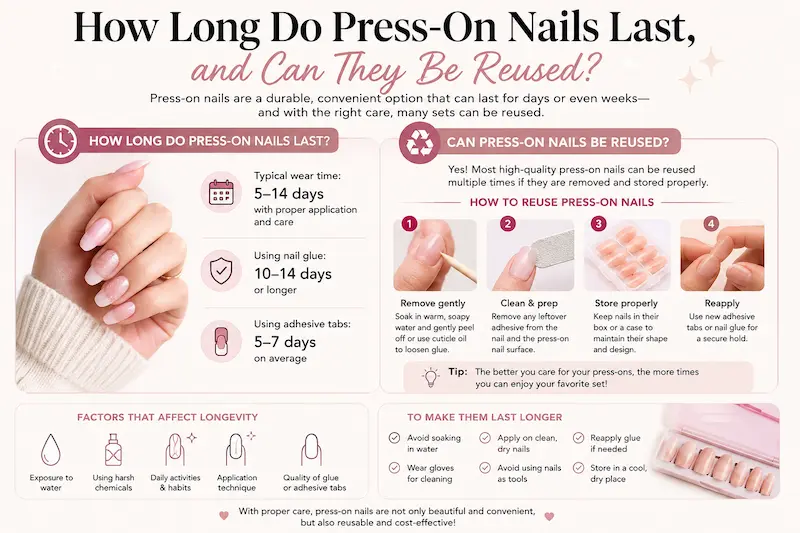
Press-on nails may stay on from a single day to around a week or longer. Adhesive tabs are usually selected for shorter or more flexible wear, while liquid nail glue generally provides a firmer bond. Pre-glued products vary by brand.
Actual wear time depends on fit, nail preparation, adhesive coverage, water exposure, nail length, and daily activities. Manufacturer wear claims are product-specific estimates rather than guarantees. A nail that develops significant lifting should be removed and checked rather than kept on simply to reach a target number of days. Learn more about the factors that determine how long press-on nails last.
Some durable press-ons can be reused if they are removed gently, remain unwarped and uncracked, and can be cleaned without damaging the underside or decoration. Tabs are often more reuse-friendly because they leave less hardened residue. Thin pre-glued nails and damaged pieces are more likely to be single-use. Detailed instructions for maximizing wear, removing glue, and cleaning reusable sets belong in separate guides because those tasks depend heavily on the exact adhesive and product construction.
10. Frequently Asked Questions About Press-On Nails
Do press-on nails go over your real nails?
Yes. Each press-on covers the visible surface of the natural nail and attaches with glue, an adhesive tab, or a built-in adhesive layer.
Are press-on nails already painted?
Most ready-to-wear sets already have their color and design finished. Clear or blank full-cover tips are also available for people who want to create their own artwork.
Do all press-on nails require glue?
No. Some use separate adhesive tabs, while others come with adhesive already applied. The best method depends on the product and intended wear time.
Do press-on nails need a UV or LED lamp?
Typical press-ons do not. Glue, tabs, and pre-applied adhesives work without lamp curing. A product bonded with gel and cured under a lamp belongs to a different extension system.
Can press-on nails look natural?
Yes. A natural appearance depends mainly on choosing the correct width and curve, aligning the cuticle edge neatly, avoiding visible adhesive, and selecting a proportionate shape and length.
Are press-on nails the same as acrylic nails?
No. Press-ons are finished nails attached as complete pieces. Acrylic extensions are built from liquid and powder directly on the nail, a tip, or a sculpting form.
Are press-on nails safe for natural nails?
They can be worn without major problems when applied to healthy nails, used as directed, and removed without force. Irritation, poor fit, aggressive buffing, and forceful removal can still cause problems. Read our full guide addressing are press-on nails safe for a more detailed overview.
Can press-on nails be reused?
Some can, especially durable sets applied with tabs. Reuse depends on the nail remaining clean, intact, flat, and comfortable after removal. Follow our guide on how to reuse press-on nails before preparing a set for another application.
Final Thoughts
Press-on nails are pre-shaped, ready-to-apply artificial nails that can add color, artwork, length, and shape without a salon-built extension. They attach with glue, adhesive tabs, or a built-in adhesive layer and are available in styles ranging from short everyday nails to highly detailed custom designs.
Their success depends less on choosing the strongest possible adhesive and more on finding the correct fit, preparing the natural nails properly, matching the attachment method to the intended wear, and removing the set patiently.
For deeper guidance, continue with dedicated articles on choosing the right size, applying press-ons, comparing glue and tabs, extending wear time, safe removal, reuse, and press-on nails versus acrylic or gel extensions.