Application & Nail Care
Best Nail Glue for Press-On Nails: How to Choose the Right Adhesive
Choosing the best nail glue for press-on nails can make your set feel more secure, look cleaner, and last longer. But the strongest glue is not always the best choice.
The right adhesive depends on how long you want to wear your nails, whether you want to reuse the set, how well the press-ons fit your natural nail beds, and how comfortable you are with application and removal.
This guide focuses on one specific question: what type of nail glue or adhesive should you use for press-on nails? For a complete beginner overview, start with Hana Nail’s ultimate guide to press-on nails.
1. Quick Answer: The Best Nail Glue for Most Press-On Nails
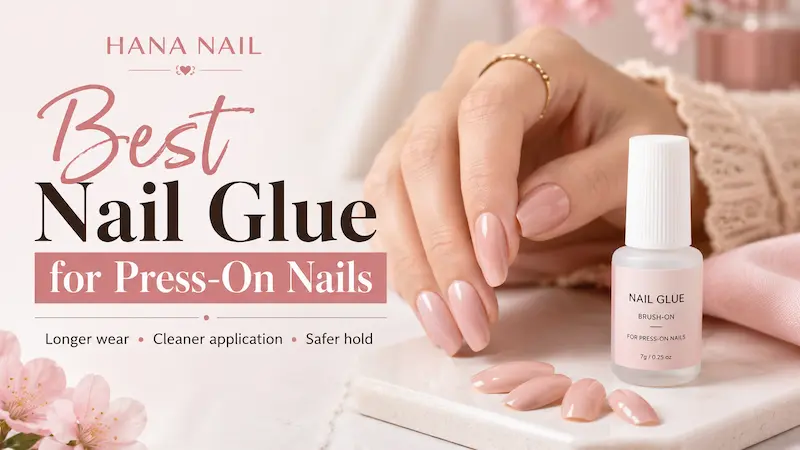
For most press-on nails, the best everyday option is a brush-on nail glue made for artificial nails. Brush-on glue is easier to control than a squeeze tube, helps you apply a thin and even layer, and reduces the chance of glue flooding the cuticle area.
If you want longer wear, liquid nail glue usually holds better than adhesive tabs. If you want to reuse your press-ons or wear them for only a short event, adhesive tabs are usually the better choice. Review our adhesive tabs vs nail glue comparison before choosing a product
| Your Goal | Best Adhesive Type | Why It Works |
| Longest wear | Brush-on nail glue | Thin, even coverage with better control |
| Beginner-friendly application | Brush-on glue or glue pen | Less mess than runny squeeze tubes |
| Reusable press-ons | Adhesive tabs | Easier removal and less glue residue |
| Small repairs | Precision-tip nail glue | Targets one lifted edge or one nail |
| Flat or wide nail beds | Correct sizing + brush-on glue | Fit matters more than adding extra glue |
| Sensitive nails or skin | Tabs or minimal glue use | Less direct exposure to liquid adhesive |
A simple rule: use nail glue for longer wear, use adhesive tabs for temporary or reusable wear, and avoid household super glue for cosmetic nail use.
2. What We Look for in a Good Press-On Nail Glue
A good nail glue is not just “strong.” For press-ons, the best glue should help you apply a clean bond, avoid over-application, and remove the set without unnecessary damage.
| Factor | Why It Matters | Best Choice |
| Applicator control | Prevents flooding the cuticle and skin | Brush-on or precision tip |
| Glue thickness | Helps avoid bubbles, gaps, and uneven pressure | Medium-viscosity formula |
| Dry time | Balances secure hold with enough placement time | Fast, but not impossible to adjust |
| Wear goal | Long wear and reusable wear need different adhesives | Glue for long wear; tabs for reuse |
| Removal difficulty | Over-applied glue is harder to remove safely | Thin, even layer |
| Ingredient transparency | Helps users understand allergy and irritation risks | Clear ingredient list and usage instructions |
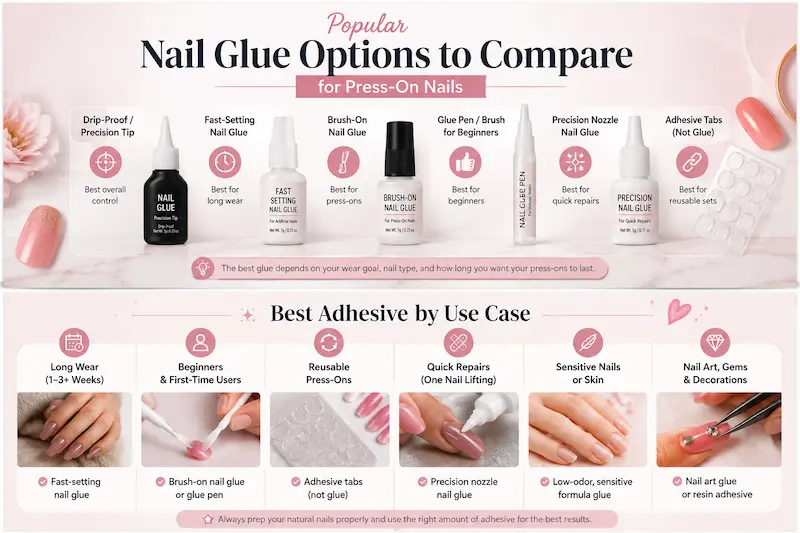
3. Popular Nail Glue Options to Compare for Press-On Nails
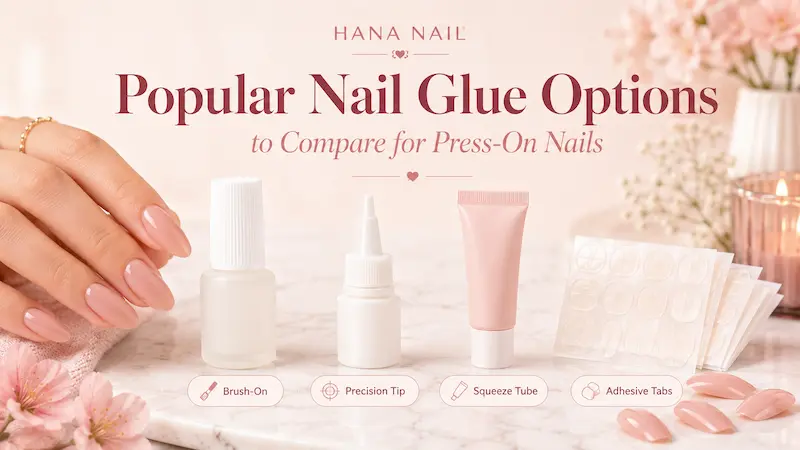
The examples below are popular nail glue options and adhesive formats to compare. They are not one-size-fits-all recommendations. The best choice still depends on your press-on fit, wear goal, nail prep, and removal routine.
| Best For | Example or Glue Type | Why It May Work | What to Consider |
| Overall control | Beauty Secrets Drip & Clog Proof Nail Glue | Designed for more precise application and less clogging | Still requires thin, careful placement |
| Longer wear | KISS PowerFlex Max Speed Nail Glue | Fast-setting, strong-hold style of glue | Can be easy to over-apply from a tube |
| Press-on sets | Glamnetic Brush-On Nail Glue | Brush applicator helps create an even layer | Good fit and prep still matter |
| Brush-on application | Static Nails Brush-On Nail Glue | Brush format can give more placement control | Dry time may feel slower for some users |
| Beginners | Young Nails Brush-On Glue | Intuitive brush format and easier control | May not be the longest-wearing option for everyone |
| Quick repairs | Precision nozzle glue | Targets one lifted nail or edge | Not always ideal for full-set application |
| Reusable press-ons | Adhesive tabs | Easier removal and less glue residue | Usually shorter wear than liquid glue |
3.1. Best Overall Control: Drip-Proof or Precision-Tip Nail Glue
A drip-proof or precision-tip nail glue is useful if you struggle with applying too much product. This format lets you place a smaller amount of glue exactly where the press-on nail needs it.
Choose this if you want cleaner application and better control. Avoid it if you prefer a brush-on format for full-set application.
3.2. Best for Long Wear: Fast-Setting Nail Glue
Fast-setting nail glue can work well when you want your press-ons to stay secure for daily wear, travel, or events. The tradeoff is that faster glues usually give you less time to reposition the nail.
Choose this if you are comfortable applying press-ons quickly. Avoid it if you are new to press-ons or tend to over-apply glue.
3.3. Best for Most Press-On Sets: Brush-On Nail Glue
Brush-on nail glue is the most balanced option for many press-on users. It applies more like polish, so it is easier to create a thin, even layer without squeezing out too much glue.
Choose this if you want a cleaner full-set application. Avoid it if you only need to repair one tiny lifted corner, where a precision nozzle may be easier.
3.4. Best for Beginners: Brush-On Glue or Glue Pen
Beginners should prioritize control over maximum strength. A brush-on glue or glue pen makes it easier to avoid flooding the cuticle area and getting glue on the skin.
Choose this if you are applying press-ons for the first time. Avoid very runny squeeze tubes until you are comfortable with placement.
3.5. Best for Reusable Press-Ons: Adhesive Tabs
If reusability is your priority, adhesive tabs are usually better than liquid glue. They are easier to remove and leave less residue on the back of the press-on nail.
For a full reuse routine, read Hana Nail’s guide on how to reuse press-on nails safely.
4. Brush-On Glue vs Squeeze Tube vs Precision Nozzle
| Format | Best For | Main Advantage | Main Caution |
| Brush-on glue | Full-set application, beginners | Smooth, thin coverage | Brush can dry out if bottle is left open |
| Squeeze tube | Experienced users, stronger hold | Fast and widely available | Easy to apply too much |
| Precision nozzle | Repairs and lifted corners | Targets small areas | Can be too runny for full sets |
For most Hana Nail customers, brush-on glue is the easiest starting point because it supports a thin, controlled application. A squeeze tube can still work well, but it is less forgiving if too much glue comes out at once.
5. Nail Glue vs Adhesive Tabs vs Gel Adhesive
Product names can be helpful, but the real decision is the adhesive type. Nail glue, adhesive tabs, and gel adhesive behave differently on press-on nails.
5.1. Traditional Nail Glue
Traditional nail glue is best when you want a longer-lasting press-on manicure. It usually gives a stronger bond than tabs, but it also requires more careful removal.
For a full application routine, read Hana Nail’s guide on how to apply press-on nails.
5.2. Adhesive Tabs
Adhesive tabs are best for short-term wear, quick style changes, and reusable press-on sets. They usually do not last as long as glue, but they make removal and cleanup easier.
5.3. Gel Adhesive or UV/LED Adhesive
Only use gel adhesive if the press-on system is designed for it and the instructions clearly explain how to cure it. If a press-on nail is too opaque or too thick, a UV/LED adhesive may not cure properly.
5.4. Can You Use Super Glue for Press-On Nails?
It is not recommended to use household super glue for press-on nails. Some nail glues and super glues may share cyanoacrylate chemistry, but household super glue is not designed or labeled for cosmetic nail use. Choose a product labeled for artificial nails, press-on nails, or nail tips.
6. Best Adhesive by Use Case
6.1. For Long-Lasting Press-Ons
Use brush-on nail glue or a controlled artificial-nail glue. Apply a thin, even layer and make sure the press-on fits from sidewall to sidewall before pressing it down.
For longevity beyond adhesive choice, see Hana Nail’s guide on how to make press-on nails last longer.
6.2. For Flat or Wide Nail Beds
The best glue cannot fix a poor fit. If the press-on nail does not sit flush, extra glue may create pressure, bubbles, or lifting. Choose the correct size first, then use a controlled brush-on glue for even coverage.
For sizing help, read how to size press-on nails correctly.
6.3. For One Nail That Lifts or Falls Off
Use a precision-tip glue or a small amount of brush-on glue. Clean the natural nail and the back of the press-on first instead of applying new glue over oil, dust, or old buildup.
For a full repair routine, read how to fix a press-on nail that falls off.
6.4. For Sensitive Nails or Skin
Adhesive tabs may be a better starting point if your skin is sensitive, because they reduce direct exposure to liquid glue. If you use glue, keep it away from the cuticle and surrounding skin.
7. Ingredients and Claims to Understand
You do not need to be a chemist to choose nail glue, but it helps to understand common ingredient categories and marketing claims.
7.1. Ethyl Cyanoacrylate
Ethyl cyanoacrylate is commonly used in quick-bonding nail glues. It helps artificial nails attach quickly, but it should be kept away from the skin, cuticles, and surrounding tissue.
7.2. Acrylates and Methacrylates
Some nail products contain acrylates or methacrylates, which may trigger allergic contact dermatitis in some people. Possible warning signs include redness, itching, burning, swelling, blistering, irritation around the nail, or nail lifting.
7.3. “Non-Toxic,” “Hypoallergenic,” and “Vegan” Claims
These labels can be useful, but they do not guarantee that a glue will never cause irritation. A product can be vegan and still unsuitable for someone with a specific allergy. Follow the product directions and stop using it if irritation appears.
8. How to Apply the Right Amount of Nail Glue
This section is intentionally brief because this article is about choosing glue, not a full application tutorial.
- Start with clean, dry nails and remove surface oils before applying glue.
- Apply a thin, even layer to the natural nail, the press-on, or both, depending on the glue instructions.
- Avoid flooding the cuticle area or letting glue touch the skin.
- Place the press-on near the cuticle line, press down firmly, and hold steady pressure.
- Avoid soaking your hands immediately after application.
For the complete step-by-step routine, read Hana Nail’s guide on how to apply press-on nails.
9. When Glue Is Not the Real Problem
If your press-ons still pop off, the glue may not be the main issue. Use this quick troubleshooting table before switching products.
| Problem | Is It Glue-Related? | What to Do |
| Too much glue | Yes | Use a thinner, more even layer |
| Too little glue | Yes | Cover the contact area without flooding the cuticle |
| Wrong nail size | Not mainly | Check sizing before applying |
| Oily or wet nail plate | Partly | Clean and dry the nail surface first |
| Press-on does not sit flush | Not mainly | Choose a better-fitting size or shape |
| Nails used as tools | Not mainly | Avoid prying, opening cans, or scraping surfaces |
For deeper troubleshooting, read Hana Nail’s guide on why press-on nails keep falling off.
10. Nail Glue Safety Notes
Nail glue is useful, but it should be handled carefully. This guide is for general nail care education and is not medical advice.
- Keep glue away from skin, cuticles, eyes, and mouth.
- Do not apply glue over painful, bleeding, swollen, split, lifting, or infected nails.
- Stop using nail glue if you notice redness, itching, burning, swelling, blistering, rash, nail lifting, or ongoing discomfort.
- If symptoms are severe or persistent, contact a qualified healthcare professional or dermatologist.
- Keep nail glue closed tightly and store it away from children and pets.
- Avoid contact between larger amounts of cyanoacrylate glue and cotton or wool fabrics, because heat can be generated during curing.
For safe removal, see Hana Nail’s guide on how to remove press-on nails without damage.
11. Hana Nail Recommendation
For most Hana Nail press-on sets, choose your adhesive based on your wear goal:
- For longer wear: use a thin layer of brush-on nail glue and apply it only to clean, dry nails.
- For reusable sets: use adhesive tabs when you want easier removal and less glue residue.
- For beginners: start with tabs or brush-on glue rather than a runny squeeze tube.
- For the best hold: prioritize correct sizing and nail prep before adding more glue.
12. FAQ: Best Nail Glue for Press-On Nails
What is the best nail glue for press-on nails?
For most people, the best nail glue for press-on nails is brush-on nail glue made for artificial nails. It gives better control and helps create a thin, even bond.
Is brush-on nail glue better than squeeze-tube glue?
Brush-on glue is often better for beginners because it is easier to control. Squeeze-tube glue can still work well, but it is easier to apply too much.
How long does nail glue last on press-on nails?
With good sizing, proper prep, and careful application, press-ons applied with glue can often last about 7–14 days. Wear time varies by lifestyle, nail shape, glue type, and removal habits.
Can I use super glue for press-on nails?
It is not recommended to use household super glue for press-on nails. Use nail glue labeled for artificial nails, nail tips, or press-on nails.
What nail glue is best for reusable press-ons?
If you want to reuse your press-ons, adhesive tabs are usually better than liquid glue because they are easier to remove and leave less residue.
Why do my press-on nails pop off even with glue?
Common reasons include wrong sizing, oily or wet nails, too much glue, too little glue, air bubbles, poor fit, or using your nails as tools.
How do I remove nail glue without damaging my nails?
Do not rip or pry the nails off. Soak and loosen the adhesive gently, then remove residue carefully. See Hana Nail’s full removal guide for the step-by-step routine.
Final Takeaway
The best nail glue for press-on nails is not simply the strongest glue. It is the adhesive that matches your wear goal, nail fit, skill level, and removal plan.
For longer wear, choose a controlled brush-on nail glue and apply a thin, even layer. For reusable press-ons, choose adhesive tabs. For the best result, pair the right adhesive with correct sizing, clean nail prep, and gentle removal.
Sources and Editorial References
- Byrdie — These Are the 13 Best Nail Glues That Secure Press-Ons and Nail Gems All Day Long: https://www.byrdie.com/best-nail-glues-4845424
- U.S. FDA — Nail Care Products: https://www.fda.gov/cosmetics/cosmetic-products/nail-care-products
- DermNet — Nail cosmetics allergy: https://dermnetnz.org/topics/nail-cosmetics-allergy
- DermNet — Allergy to acrylates: https://dermnetnz.org/topics/allergy-to-acrylate
- NIH / PubMed Central — Adverse Effects of Do-It-Yourself Nail Cosmetics: A Literature Review: https://pmc.ncbi.nlm.nih.gov/articles/PMC11147520/
- Poison Control — Super Glue: https://www.poison.org/articles/super-glue