Buying Guides & Comparisons
Press-On Nails vs Acrylics: Which Is Better for You?
Press-on nails and acrylic nails can both create a polished, salon-style manicure, but they are designed for different lifestyles.
Press-on nails are generally better for people who want fast at-home application, lower recurring costs, and the freedom to change designs frequently. Acrylic nails are usually better for those who prioritize maximum strength, longer continuous wear, and extensions sculpted specifically for their nails.
The right option depends on your budget, schedule, preferred length, daily activities, and willingness to maintain the manicure.
Hana Nails specializes in press-on nails, but this comparison also explains the situations in which acrylic nails may be the more practical choice.
Quick answer: Choose press-on nails for convenience, affordability, and flexibility. Choose acrylic nails for maximum rigidity, very long extensions, and fully customized salon sculpting.
1. Press-On Nails vs Acrylic Nails at a Glance
| Factor | Press-On Nails | Acrylic Nails |
|---|---|---|
| Application | Pre-made nails attached with tabs or glue | Acrylic product sculpted over the natural nail or an extension |
| Where applied | Usually at home | Usually at a nail salon |
| Application time | Often around 10–30 minutes | Commonly one hour or longer |
| Wear style | Temporary to medium-term wear | Continuous wear maintained through fills |
| Durability | May loosen or pop off under pressure | More rigid and impact-resistant |
| Cost | Usually lower and more flexible | Higher initial and recurring salon costs |
| Removal | Often manageable at home with the correct method | Usually involves filing and soaking |
| Best for | Beginners, events, travel, and frequent design changes | Maximum strength, long extensions, and custom sculpting |
These are general differences rather than guarantees. Results depend on product quality, fit, preparation, application, daily activities, and removal technique.
2. What Is the Main Difference Between Press-On and Acrylic Nails?
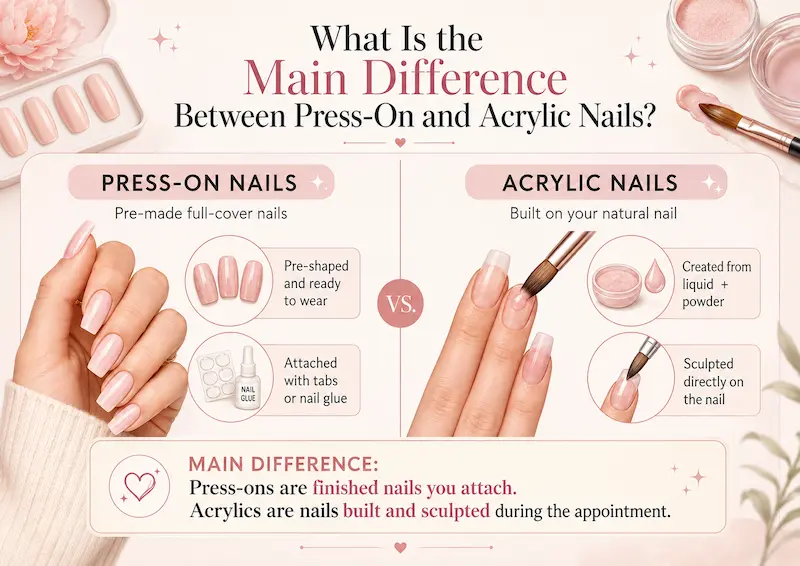
Press-on nails are pre-shaped, full-cover artificial nails that are attached to the natural nails with adhesive tabs or nail glue. Their shape, length, and design are completed before application, allowing most users to apply them at home.
Acrylic nails are created by combining liquid monomer with polymer powder. A nail technician shapes the mixture over the natural nail or an extension tip. Traditional acrylic hardens through a chemical reaction and does not require a UV lamp to cure.
The key distinction is therefore simple:
- Press-ons are finished nails that are attached.
- Acrylic nails are built and sculpted during the appointment.
This difference affects application time, durability, cost, maintenance, removal, and customization.
For a fuller introduction to press-ons, read our guide to what press-on nails are.
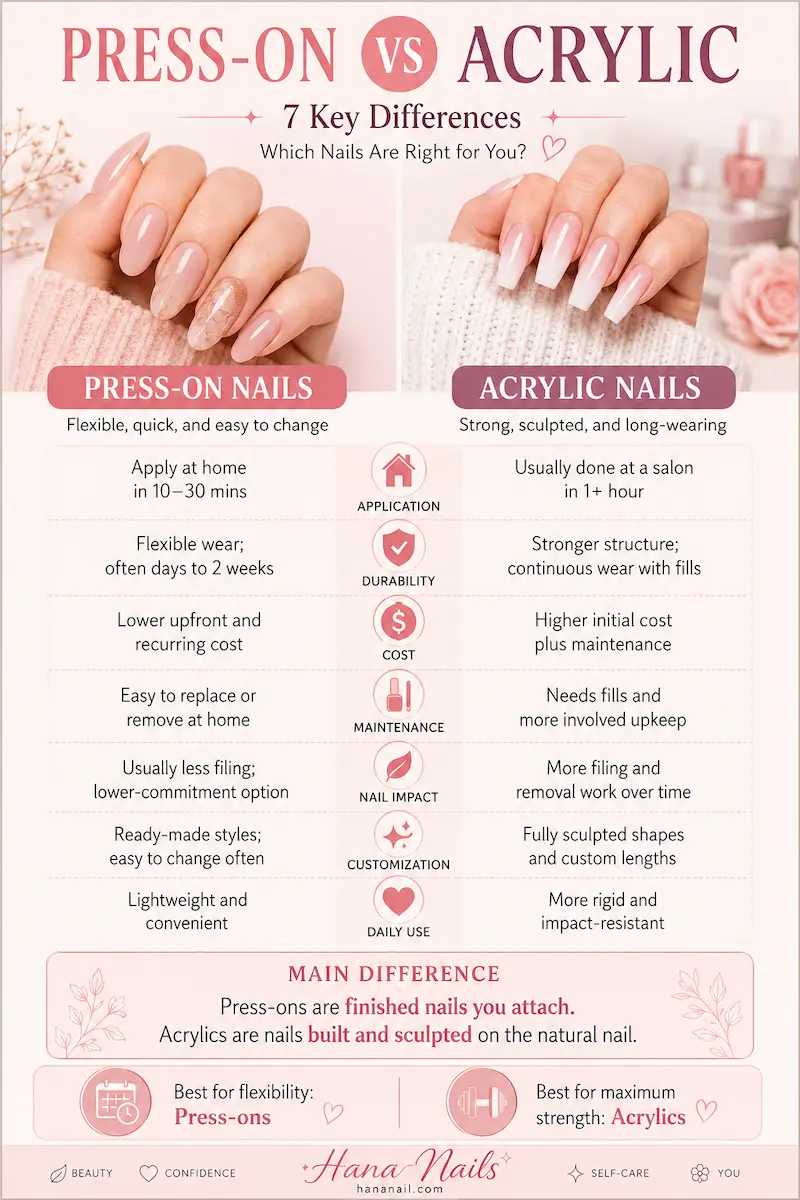
3. Press-On Nails vs Acrylics: 7 Key Differences
3.1. Application Time and Skill
Press-on nails are designed for convenient at-home application. After selecting the correct size, the wearer prepares the natural nails and attaches each press-on with tabs or glue.
The process often takes around 10 to 30 minutes, although beginners may need longer while learning how to size and position the nails correctly.
Professional training is not required, but technique still affects the result. An incorrectly sized nail may feel uncomfortable, look bulky, or lift sooner than expected.
Acrylic nails require more specialized knowledge and equipment. The technician must mix the acrylic correctly, control the product, build an appropriate structure, shape the extensions, file the surface, and complete the finish or nail art.
Appointments commonly take one hour or more, especially for long extensions or complex designs. Additional time is also needed for future fills and repairs.
Press-ons are therefore the more practical option when speed, convenience, and at-home application are the priority. Acrylics are better suited to people who prefer professional application and do not mind regular salon appointments.
Best for fast, beginner-friendly application: Press-on nails.
For step-by-step instructions, read how to apply press-on nails correctly.
3.2. Wear Time and Durability
Acrylic nails are generally stronger and more rigid than press-ons. Their sculpted structure is designed for continuous wear and can withstand more everyday impact.
However, acrylic nails do not remain unchanged indefinitely. As the natural nails grow, a gap develops near the cuticle, and the extensions need regular fills to maintain their appearance and balance.
Press-on nails offer more flexible wear.
A set applied with adhesive tabs may be suitable for an event, weekend, or short trip. Nail glue usually creates a stronger bond and can help a properly fitted set remain attached for longer.
Actual press-on wear time varies according to:
- Nail preparation
- Adhesive type
- Fit and sizing
- Product quality
- Water exposure
- Daily hand use
Press-ons are more likely than acrylics to loosen or pop off under strong pressure. Acrylic nails are harder, but they can still crack, lift, or place stress on the natural nail if a long extension catches on an object.
Choose acrylics when maximum rigidity and uninterrupted wear matter most. Choose press-ons when you want secure wear without committing to the same manicure for several weeks.
Best for maximum strength and continuous wear: Acrylic nails.
Learn more in how long press-on nails last and how to make press-on nails last longer.
3.3. Initial Cost and Long-Term Expense
Press-on nails usually have a lower upfront cost because the wearer purchases a finished set and completes the application at home.
Additional expenses may include adhesive tabs, nail glue, or basic preparation tools. Some press-on sets may also be reusable when they are removed carefully and remain in good condition.
Acrylic nails include both product and professional service costs. Prices vary according to the salon, location, length, shape, and complexity of the design.
Continuous acrylic wear can also involve:
- Fill appointments
- Repairs
- Design changes
- Professional removal
- Tips and transportation
This means the fairest comparison is not simply the price of one press-on set versus one acrylic appointment. The total cost depends on how frequently the wearer changes designs, whether acrylics are maintained continuously, and how many successful wears you get from each set. For a deeper breakdown, read our guide to how much press-on nails cost, including craftsmanship, reuse, and cost per wear.
Press-ons offer more control over spending. You can purchase a set only when needed, alternate between bare nails and artificial nails, or reuse certain sets.
Acrylics may still provide good value for someone who prefers one manicure for an extended period and values professional sculpting. However, they generally require a higher recurring commitment.
Best for lower and more controllable costs: Press-on nails.
3.4. Maintenance and Removal
Press-ons generally require less structured maintenance.
If one nail loosens or comes off, it may be possible to remove the old adhesive, clean the surfaces, and reapply the nail at home. This is useful for travel and busy schedules because a small repair does not always require a salon visit.
Acrylic nails grow forward with the natural nails. The exposed area near the cuticle must be filled with new product, and the technician may need to rebalance or reshape the extension.
Cracks, significant lifting, pain, or discoloration should not simply be covered with more acrylic. These issues may require professional attention before the manicure is continued.
Removal is also different.
Press-ons can often be removed at home, but they should never be pulled or forced off. Adhesive tabs usually allow easier removal, while glue requires more patience to loosen safely.
Acrylic removal normally involves reducing the product through filing and then soaking or using another professional technique. Peeling acrylic from the natural nail can remove surface layers of the nail plate.
Some press-on sets can be cleaned and reused after careful removal. Acrylic nails are maintained through fills rather than removed and reused as a separate set.
Best for flexible maintenance and at-home repairs: Press-on nails.
See how to remove press-on nails without damage, how to fix a press-on nail that falls off, and how to reuse press-on nails.
3.5. Natural Nail Impact and Chemical Exposure
Neither press-on nor acrylic nails are automatically harmless or damaging. The condition of the natural nails depends on product quality, preparation, application, wear habits, and removal.
Press-ons usually require less structural alteration to the natural nail. Preparation may involve cleaning the nail plate and lightly removing surface shine.
Excessive buffing should still be avoided. Nail glue can also irritate the skin or cause an allergic reaction in some users, particularly when it touches the cuticle area or broken skin.
Acrylic application commonly involves more filing and repeated maintenance. Additional filing and acetone exposure may also be part of the removal process.
These procedures can leave natural nails feeling dry, thin, or sensitive, especially when the extensions are removed aggressively or worn continuously without appropriate care.
Acrylic monomers, nail adhesives, and other nail products can all cause irritation in susceptible users. Correct handling, ventilation, hygiene, and skin protection are therefore important.
Press-ons may be the lower-commitment option because they generally require less filing and do not need ongoing fills. However, they are not completely damage-free. Pulling off a glued press-on can remove layers from the natural nail.
Acrylic nails also do not inevitably destroy the natural nails when they are professionally applied, maintained, and removed.
Neither method is risk-free when applied or removed incorrectly.
Read are press-on nails safe and can press-on nails damage natural nails for more detailed guidance.
3.6. Appearance, Fit, and Customization
Both press-ons and acrylic nails can look polished and professional.
Acrylic nails provide greater structural customization because the technician can adjust the length, apex, thickness, shape, and balance of each nail during application.
This makes acrylics especially suitable for:
- Extreme lengths
- Dramatic shapes
- Individually sculpted proportions
- Complex custom nail art
Press-ons arrive pre-shaped, so their appearance depends heavily on fit.
A nail that is too large may overlap the skin or look bulky. A nail that is too small may leave the sidewalls exposed or create pressure. The curvature and cuticle shape should also match the natural nail as closely as possible.
Well-made press-ons are available in many shapes, lengths, finishes, and detailed designs. Handmade and custom-sized sets can offer an even more personalized result.
Press-ons also allow users to own several completed designs and change between them without reshaping or repainting an existing manicure.
Acrylics have the advantage when every part of the nail must be sculpted during the appointment. Press-ons have the advantage when finished designs and frequent style changes are more important.
Best for fully customized sculpting: Acrylic nails.
Best for changing finished designs frequently: Press-on nails.
For a more seamless result, read how to size press-on nails correctly.
3.7. Comfort and Daily Use
Comfort depends more on nail length, thickness, shape, and fit than on the manicure system alone.
Press-ons are often lighter and may feel less permanent. A correctly sized set should not pinch the sidewalls, press into the cuticle, or create uncomfortable pressure.
Acrylic nails are more rigid. This may feel secure to experienced wearers, but long or thick extensions can require an adjustment period.
For typing, cleaning, exercise, and hands-on work, shorter nails are generally more practical regardless of whether they are press-ons or acrylics.
Press-ons may loosen when exposed to frequent water or strong pressure, while acrylics may crack or transfer more force to the natural nail if they catch on an object.
Neither type should be used to open cans, scrape surfaces, or separate objects.
Choose the shape and length according to your daily routine rather than appearance alone.
Best for lightweight and occasional wear: Press-on nails.
Best for users who prefer a firm, rigid extension: Acrylic nails.
4. Which Option Is Better for Your Lifestyle?
| Situation | Recommended Option | Why |
|---|---|---|
| You need nails for a weekend or event | Press-ons | They can be applied and removed with less commitment |
| You change designs frequently | Press-ons | Finished sets are easy to switch |
| You have a limited beauty budget | Press-ons | They usually involve lower recurring costs |
| You want maximum impact resistance | Acrylics | Their structure is generally stronger |
| You want very long sculpted nails | Acrylics | A technician can customize the full structure |
| You work heavily with your hands | Short nails of either type | Length and fit are more important than the system |
| You do not want salon appointments | Press-ons | Application and small repairs can be handled at home |
| You want the same manicure for several weeks | Acrylics | They are designed for continuous wear with fills |
Some users alternate between the two. Press-ons may be used for everyday design changes and special events, while acrylics may be reserved for periods when maximum durability or custom sculpting matters more.
5. Final Verdict: Are Press-On Nails Better Than Acrylics?
Press-on nails are better for convenience, lower costs, at-home application, frequent design changes, and lower commitment.
Acrylic nails are better for maximum rigidity, very long extensions, continuous wear, and fully customized salon sculpting.
For beginners, busy users, occasional wearers, and people who enjoy changing their style, press-ons are often the more flexible choice.
For users who prioritize strength and professional customization above time, cost, and maintenance, acrylics may be more suitable.
The best option is the one that matches your natural nails, daily routine, budget, and expectations.
Explore Hana Nails press-on nail designs to find a shape and style suited to your routine.
6. Frequently Asked Questions
Are Press-On Nails Made of Acrylic?
Not all press-on nails are made from the same material.
Depending on the manufacturer, they may be made from ABS plastic, soft gel, resin-based materials, or other synthetic nail-tip materials.
The phrase “acrylic press-on nails” is sometimes used to describe thick or salon-style press-ons, but they are not the same as traditional acrylic extensions.
Acrylic nails are sculpted from liquid monomer and polymer powder. Press-ons arrive pre-shaped and are attached with tabs or glue.
Check the product description when the exact material matters to you.
Do Press-On Nails Last as Long as Acrylic Nails?
Press-ons generally do not provide the same continuous wear or rigidity as acrylic nails.
Acrylics are designed to remain on the nails and be maintained through fills as the natural nails grow.
Press-on wear time depends on the adhesive, preparation, sizing, water exposure, daily activities, and product quality. Adhesive tabs are usually better for short-term wear, while nail glue can provide a longer-lasting bond.
Which Is More Damaging: Press-On Nails or Acrylic Nails?
Acrylic nails generally involve more filing, maintenance, and removal work, while press-ons usually require less alteration of the natural nail.
However, either option can cause damage when applied or removed incorrectly.
Press-ons may remove surface layers if they are peeled off. Acrylics may leave the nails thin or sensitive after aggressive filing or removal.
Proper technique is more important than assuming that one method is completely safe or always damaging.
Can I Wear Press-On Nails After Removing Acrylics?
You may wear press-ons after acrylic removal when the natural nails and surrounding skin appear healthy.
Do not immediately cover nails that are painful, swollen, discolored, separated from the nail bed, or severely damaged.
Begin with a short, lightweight set. Adhesive tabs may provide a lower-commitment way to test comfort before using nail glue.
Press-ons can cover the nails cosmetically, but they do not repair existing nail damage.