Buying Guides & Comparisons
Are Press-On Nails Worth It? An Honest Look at the Pros and Cons
Press-on nails promise a polished manicure without the appointment, drying time, or long-term commitment of many salon services. They are available in countless shapes and designs, can be applied at home, and often have a lower upfront cost than professionally applied extensions.
But are press-on nails actually worth it—and do they work well enough to replace a salon manicure?
For many people, press-on nails are worth it because they provide convenience, design flexibility, and greater control over when a manicure is applied or removed. A properly fitted set can look natural, feel comfortable, and remain secure through normal daily activities.
However, press-ons are not the ideal choice for everyone. Their performance depends on fit, nail preparation, adhesive choice, product quality, and lifestyle. Someone who needs a manicure for an event or enjoys changing designs may find them extremely valuable. Someone who performs demanding manual work or expects every set to remain secure for several weeks may prefer a professional salon service.
At Hana Nails, we design and sell press-on nails, so this guide is written from a brand perspective rather than presented as an independent product review. Our goal is to explain both the benefits and the limitations so you can decide whether press-ons match your needs.
Quick answer: Press-on nails are usually worth it if you value convenience, design variety, and a lower-commitment manicure. They may be less suitable if you need maximum durability, frequently perform demanding work with your hands, have difficulty finding a comfortable fit, or are sensitive to nail adhesives.
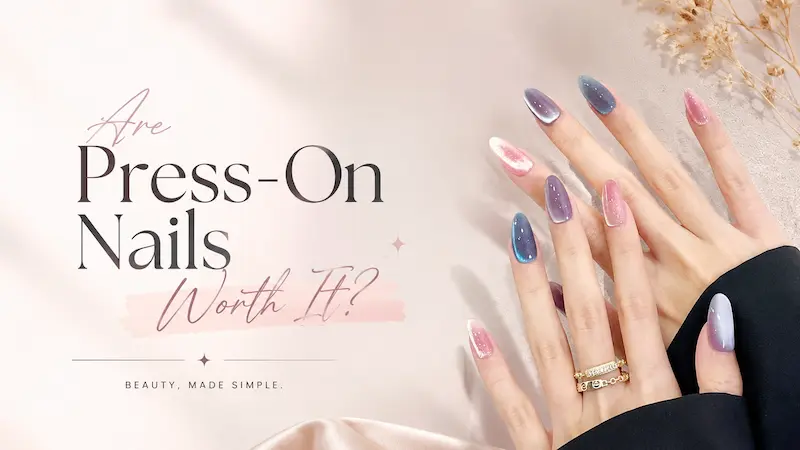
1. Are Press-On Nails Worth It? The Short Verdict
Yes, press-on nails can be worth it-but their value depends on what you expect from your manicure.
They tend to provide the greatest value for people who want attractive nails without scheduling frequent salon appointments. They can be applied at home, changed when needed, and selected for a specific outfit, occasion, or season.
They can also work for everyday wear when the length is practical, the sizes fit correctly, and the adhesive matches the intended wear time.
The trade-off is that press-on wear may be less predictable than a professionally applied enhancement. A set can lift early if it does not match the natural nail curve, is applied over oil or moisture, or is repeatedly exposed to pressure.
| Press-on nails are usually worth it if… | They may not be worth it if… |
|---|---|
| You want to apply your manicure at home | You want every set to remain unchanged for several weeks |
| You value convenience and quick style changes | You do not want to size or prepare your natural nails |
| You enjoy changing shapes, colors, and designs | You prefer keeping the same manicure for a long time |
| You need nails for an event, trip, or short period | Your work involves tools, lifting, or repeated impact |
| You want an alternative to frequent salon visits | Your hands are constantly exposed to water or chemicals |
| You prefer a removable, lower-commitment manicure | Standard sizes rarely fit your nail beds comfortably |
| You want detailed nail art without painting it yourself | You have experienced irritation from nail adhesives |
For most users, the biggest advantages are convenience, flexibility, and design choice. The main limitations are fit, wear consistency, and the need for careful application and removal.
Press-ons should therefore be viewed as a flexible manicure option—not a guaranteed replacement for every salon service. If you are new to this manicure method, start with our guide to what press-on nails are and how they differ from other nail products.
2. Do Press-On Nails Actually Work?
Yes, press-on nails do work. However, two people can use the same set and have very different results.
One person may wear the nails comfortably for several days, while another may experience lifting much sooner. This does not always mean that the product is poor. Performance is usually influenced by four main factors.
2.1. Fit
Each press-on should cover the natural nail from sidewall to sidewall without overlapping the surrounding skin.
A nail that is too wide may look bulky or lift near the edges. A nail that is too narrow may expose part of the natural nail and provide less surface area for the adhesive.
Curvature matters as well. Some people have flatter nail beds, while others have a stronger natural arch. A major mismatch can create gaps, pressure, or early lifting.
When you fall between two widths, choosing the slightly larger nail and carefully filing the sides is usually better than forcing a nail that is too small.
For detailed fitting instructions, see our guide on how to size press-on nails correctly.
2.2. Nail Preparation
Oil, lotion, moisture, cuticle residue, and dust can weaken adhesion.
The natural nails should be clean and dry before application. Preparation may include gently pushing back excess cuticle, removing surface oil, and lightly buffing only when the product instructions recommend it.
The goal is not to aggressively file the nail plate. Excessive buffing can leave natural nails thin or sensitive.
For a full step-by-step process, see how to apply press-on nails correctly.
2.3. Adhesive Choice
Adhesive tabs and nail glue serve different purposes.
Tabs are often better for short-term wear, easier removal, and users who want a better chance of reusing the set. Nail glue generally provides a stronger hold but requires more care during application and removal.
The strongest adhesive is not automatically the best option. The right choice depends on how long you want to wear the nails and how easily you want to remove them afterward.
2.4. Lifestyle
Daily activities affect wear time.
Frequent water exposure, heavy lifting, tool use, repeated pressure on the nail tips, and very long shapes can all increase the chance of lifting or pop-offs.
A short or medium set may perform well during office work, classes, commuting, and normal household activities. The same set may be less reliable for someone who works with machinery, handles packages, or repeatedly places force on the fingertips.
When fit, preparation, adhesive, and lifestyle are aligned, press-on nails can provide a secure and polished result.
3. The Pros of Press-On Nails
3.1. They Save Time
Press-on nails can be applied at home without booking an appointment, traveling to a salon, waiting for a service, or sitting through the full shaping and design process.
The artwork and finish are already completed, so there is no polish drying time and no risk of smudging a freshly painted design.
They are particularly useful when you need polished nails for:
- A wedding or celebration
- A last-minute event
- A vacation
- A photoshoot
- A seasonal look
- An outfit change
Beginners may need additional time for sizing and alignment, but the overall process can still be more convenient than a salon appointment.
“Quick” does not mean that preparation should be skipped. Rushing the fit and application may save a few minutes but reduce wear time later.
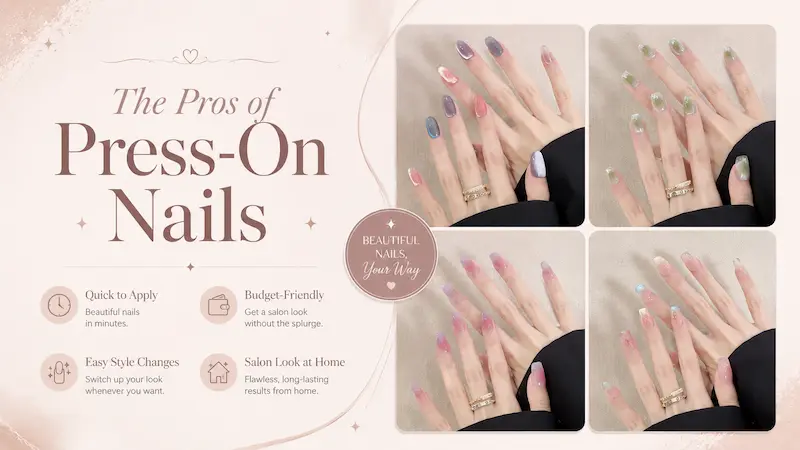
3.2. They Often Have a Lower Upfront Cost
Press-on nails are often less expensive than professionally applied extensions or detailed salon nail art.
A salon price may include the appointment, shaping, length, design, embellishments, maintenance, and removal. A press-on set combines the shape, color, length, and finished artwork into one product.
They may provide particularly good value for occasional users who only want styled nails for events, holidays, or photographs.
However, the cheapest set is not always the best value. A poorly fitted set that repeatedly lifts may cost more over time than a better-made set that fits comfortably and can be worn successfully.
A useful way to evaluate price is cost per successful wear, not just the price printed on the package.
3.3. They Make It Easy to Change Styles
Press-ons allow you to change your manicure without keeping the same design for several weeks.
You might wear short neutral nails during the week, switch to a detailed set for an event, and later return to natural nails or a different shape.
Press-ons are available in many:
- Shapes
- Lengths
- Colors
- Finishes
- Patterns
- Textures
- Embellishments
This flexibility is useful for people who coordinate nails with outfits, seasons, holidays, or personal moods.
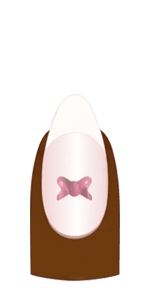
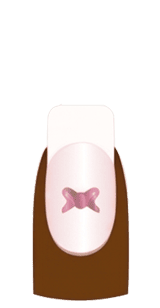
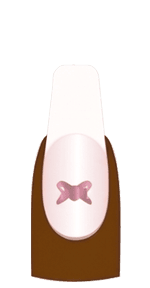
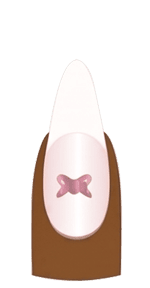
They also make it easier to experiment with almond, square, coffin, oval, or stiletto shapes before committing to a longer-wearing salon enhancement.
3.4. They Make Detailed Nail Art More Accessible
Complex nail art can require professional tools, skill, and significant appointment time.
With press-ons, the design is finished before application. You do not need to recreate the same artwork across ten nails or paint your dominant hand with your non-dominant one.
Press-ons can make styles such as cat-eye effects, floral art, chrome finishes, detailed illustrations, seasonal themes, and decorative embellishments easier to access.
Quality still varies. Some designs are printed, while others are handmade or individually painted. The final result depends on the finish, design alignment, cuticle area, and overall construction of the set.
3.5. They Offer Lower Commitment and Possible Reuse
Press-ons can be removed when the manicure is no longer needed, making them useful for people who do not want to maintain artificial nails continuously.
They may suit users who:
- Need natural nails for work or hobbies
- Prefer extensions only on weekends
- Want temporary length for an event
- Enjoy alternating between different styles
- Do not want regular fill appointments
Some sets may also be reused.
Reusability depends on the material, adhesive, removal method, and condition of the nails after wear. Adhesive tabs often make reuse easier, while strong glue may leave residue that is more difficult to remove.
Reuse should be treated as a possible benefit rather than a guarantee.
4. The Cons of Press-On Nails
4.1. Wear Time Can Be Less Predictable
One of the main disadvantages of press-on nails is that wear time can vary.
A set may stay secure when it fits well and is carefully applied, but it may lift earlier because of:
- Surface oil or moisture
- An incorrect width or curve
- Uneven adhesive
- Water exposure
- Pressure on the tips
- An impractical length
- Daily hand use
Even if most of the manicure remains secure, one missing nail can be inconvenient during travel or an important event.
Users who need highly predictable, long-term wear with minimal personal maintenance may prefer a professional salon service.
For more detail, see how long press-on nails last and how to make press-on nails last longer.
4.2. Finding the Right Fit May Take Trial and Error
Ready-made kits include multiple sizes, but they cannot match every nail bed perfectly.
Some people find suitable sizes immediately. Others need to file the edges or use custom sizing.
Poor fit may cause:
- Skin overlap
- Exposed natural nail
- Visible gaps
- Pressure or pinching
- Early lifting
- A bulky appearance
A nail should not be painfully tight or forced onto the natural nail. Persistent pressure, throbbing, or pinching usually indicates an unsuitable size or curve.
Custom-sized press-ons may improve width accuracy, but width alone does not always solve a major curvature mismatch.
4.3. They Still Require Preparation and Application
Press-ons are convenient, but they are not completely effortless.
A reliable application still requires you to:
- Match sizes
- Prepare the natural nails
- Choose an adhesive
- Position each nail accurately
- Apply even pressure
- Allow the bond to settle
Beginners may need practice before the nails look natural and remain secure.
Someone who dislikes sizing, preparation, or at-home application may receive better value from a professional manicure, even if the upfront price is higher.
4.4. Adhesive and Removal Require Care
Using too little adhesive may leave weak contact points. Using too much may cause glue to spread onto the skin or make removal more difficult.
Adhesive-related problems may include irritation, residue, lifting, trapped moisture, or damage caused by forceful removal.
Press-ons should not be pulled, peeled, or pried off while the adhesive remains strong. Removing them too aggressively may leave the natural nails rough, thin, or sensitive.
If you experience persistent pain, swelling, redness, irritation, or unusual discoloration, remove the affected nail carefully and seek appropriate professional advice if symptoms continue.
See are press-on nails safe, can press-on nails damage natural nails, and how to remove press-on nails without damage for detailed guidance.
4.5. They Are Not Ideal for Every Lifestyle
Long or heavily decorated press-ons may be impractical for certain jobs and activities.
They may be less suitable for people who:
- Perform heavy manual work
- Use tools or machinery
- Lift objects throughout the day
- Participate in contact sports or climbing
- Wear tight protective gloves
- Wash or sanitize their hands constantly
- Need very short nails for instruments or precise tasks
Some healthcare, food-handling, laboratory, and manufacturing workplaces may also restrict artificial nails for hygiene or safety reasons.
A shorter set can improve practicality, but press-ons still need to match the demands of the wearer’s routine.
5. Press-On Nails vs. Salon Nails: Which Offers Better Value?
Press-ons and salon manicures create value in different ways.
| Factor | Press-On Nails | Salon Manicure |
|---|---|---|
| Application | Applied at home | Applied by a professional |
| Time | Usually faster and requires no travel | Requires an appointment and service time |
| Upfront cost | Often lower | Usually higher |
| Fit | Depends on available sizes or measurements | Customized directly on each nail |
| Wear | Depends heavily on application and lifestyle | Often more predictable |
| Style changes | Easy to remove and replace | May require removal, filling, or another appointment |
| Maintenance | Individual nails may need reapplication | May require professional fills or repairs |
| Reuse | Possible with some sets | Usually not reusable |
| Best for | Convenience, events, changing designs | Custom fit and consistent extended wear |
Press-on nails usually provide better value when you prioritize convenience, lower commitment, and the freedom to change styles.
Salon nails often provide better value when you prioritize professional application, custom structure, and more predictable long-term wear.
Neither option is universally better. The better choice depends on your budget, schedule, nail shape, lifestyle, and expectations.
For more detailed comparisons, see press-on nails vs. acrylic nails and press-on nails vs. gel nails.
6. Who Are Press-On Nails Best For?
Press-on nails are usually a good fit for:
| Best suited for | Why they may benefit |
|---|---|
| Beginners | They can test different lengths and shapes without a long-term commitment |
| Busy users | They can apply nails at home without arranging salon appointments |
| Event and vacation users | They can wear a finished design for a specific period |
| Style-focused users | They can change designs more frequently |
| Occasional manicure users | They may not need to pay for regular salon services |
| At-home beauty users | They retain control over application and removal |
They may be less suitable for:
| Less suitable for | Main concern |
|---|---|
| Heavy manual workers | Pressure and impact may shorten wear |
| People who need highly predictable multi-week results | Press-on wear can vary |
| Users who dislike preparation | Sizing and application still require effort |
| People with repeated fitting problems | Standard widths and curves may not fit |
| Anyone with adhesive sensitivity | Glue or tabs may cause irritation |
| Workers in restricted environments | Artificial nails may not be permitted |
A press-on manicure provides the best value when its strengths match the wearer’s priorities. It provides less value when the user must constantly protect or repair the nails during ordinary activities.
7. What Makes Press-On Nails Worth the Price?
Price alone does not determine whether a set is good.
A worthwhile set should provide the following.
7.1. A Comfortable Fit
The nails should cover the natural nail without touching the skin or creating painful pressure.
7.2. A Compatible Curve
The press-on should make broad contact with the natural nail rather than leaving large gaps or needing to be forced into place.
7.3. A Natural-Looking Cuticle Area
The base should follow the natural cuticle line and avoid an excessively thick or raised appearance.
7.4. Balanced Strength and Thickness
The nails should be strong enough to hold their shape but not so thick that they look bulky or feel heavy.
7.5. A Clean and Durable Finish
Look for smooth edges, even color, aligned artwork, secure embellishments, and a finish that does not appear damaged before wear.
7.6. Clear Product Information
A trustworthy product should clearly explain:
- What sizes are included
- Whether glue or tabs are provided
- The intended wear type
- How to apply the nails
- How to remove them
- Whether reuse is realistic
- What is included in the package
Claims such as “damage-free,” “guaranteed to last,” or “always reusable” should be treated cautiously because results depend on the wearer’s nail condition, application, activities, and removal method.
For specific product recommendations, see our guide to the best press-on nails.
8. Final Verdict: Are Press-On Nails Good?
Press-on nails are worth it for many people, particularly those who value convenience, design variety, at-home application, and lower commitment.
They can provide a polished and comfortable manicure when the set fits properly and the adhesive matches the intended wear time.
Their main limitations are less predictable durability, fitting challenges, and the need for careful application and removal.
They are not automatically long-lasting, reusable, damage-free, or suitable for every lifestyle.
The most realistic approach is to choose a short or medium set for your first application, pay attention to fit, and use an adhesive that matches how long you actually want to wear the nails.
When chosen thoughtfully, press-ons can be an attractive and flexible alternative to regular salon appointments. When maximum durability, professional customization, or minimal personal maintenance matters more, a salon manicure may provide better value.
9. Frequently Asked Questions
Are Press-On Nails Worth It for One Day?
Yes. Press-on nails can be especially worthwhile for a wedding, party, photoshoot, interview, dinner, or other one-day occasion.
Adhesive tabs or pre-glued nails may be more practical than strong glue when easy removal is a priority.
Correct sizing still matters. A poorly fitted nail may feel uncomfortable or lift early even if it only needs to last for a few hours.
Do Press-On Nails Look Fake?
Poorly fitted or excessively thick press-ons can look artificial. A well-designed and correctly sized set can closely resemble a salon manicure.
A natural-looking result depends on:
– Cuticle shape
– Width
– Curvature
– Thickness near the base
– Proportionate length
– Smooth placement
Visible gaps, exposed natural nail, crooked placement, or glue around the edges can make even a good set appear less realistic.
Are Expensive Press-On Nails Worth It?
They may be worth it when the higher price reflects custom sizing, handmade artwork, stronger construction, better finishing, or realistic reuse.
However, price alone does not guarantee good fit.
A premium set that does not match your natural nail curve may provide less value than an affordable set that fits comfortably and performs well.
Judge the set by fit, construction, finish, instructions, and cost per successful wear.
Can Press-On Nails Be Reused?
Some sets can be reused, but not every set is designed for multiple applications.
Reuse depends on:
– Nail construction
– Adhesive type
– Removal method
– Glue residue
– Surface condition
– Storage
Do not reuse nails that are cracked, distorted, difficult to clean, or uncomfortable after reapplication.
See how to reuse press-on nails for a complete guide.
Are Press-On Nails Good for Beginners?
Yes. Press-ons allow beginners to experiment with artificial nails without immediately committing to a salon enhancement.
For a first set, choose:
– A short or medium length
– A practical shape
– Multiple size options
– Clear instructions
– An adhesive suited to your desired wear time
The first application may not be perfect, but it can help you identify your preferred sizes, shape, adhesive, and wear style.