Buying Guides & Comparisons
Press-On Nails vs Gel Nails: 8 Key Differences and Which Is Better
Press-on nails are usually the better option for speed, instant length, detailed nail art, and flexible wear. Gel nails are generally better when you want a thin finish applied directly to your natural nails and more predictable continuous wear.
Neither option is best for everyone. Your ideal manicure depends on how long you want to wear it, whether you want added length, how often you change styles, and how much time you want to spend on application and removal.
In this comparison, “gel nails” mainly means a gel polish manicure on natural nails. Gel-X is a different soft-gel extension system, so it is compared separately below.
Editorial transparency: Hana Nail sells press-on nails. This article compares both options using the same criteria so readers can choose the manicure that fits their needs, even when gel is the better choice.
If you are still learning the basics, start with our complete guide to press-on nails before comparing them with gel polish or Gel-X.
1. What Is the Main Difference Between Press-On and Gel Nails?
The main difference is how the manicure is built. Press-on nails are pre-shaped artificial nails attached with adhesive tabs or nail glue. Their length, shape, color, and design are usually finished before application. If you are new to them, start by learning what press-on nails are, what comes in a typical kit, and how they work.
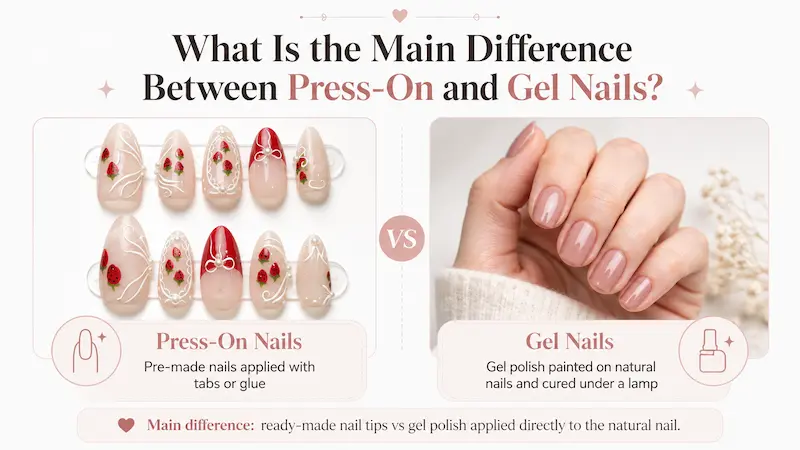
Gel polish is painted directly onto the natural nail in separate layers, which are cured under a compatible UV or LED lamp. Standard gel polish follows the existing length and general shape of the natural nail rather than creating an instant extension.
Gel-X is different from ordinary gel polish. It uses full-cover soft-gel tips bonded with a cured gel product, making it closer to a salon extension service than a traditional gel manicure.
2. Press-On Nails vs Gel Nails at a Glance
| Factor | Press-On Nails | Gel Nails |
| Application | Pre-shaped nails attached with tabs or glue | Gel polish applied in layers and cured under a lamp |
| Time | Usually faster after sizing and prep | Usually longer because each layer is applied and cured |
| Added length | Yes | Not with standard gel polish |
| Wear pattern | Ranges from event wear to longer wear depending on adhesive and fit | Usually provides more predictable multi-week wear |
| Removal | Varies by tabs, glue, and product instructions | Usually softened with acetone and removed gently |
| Reusable | Some sets can be reused | No |
| Equipment | No curing lamp required | Compatible gel products and curing lamp required |
| Best for | Quick changes, instant length, detailed designs, lower commitment | Thin finish, continuous wear, natural nail coverage |
Quick answer: press-ons win on speed, flexibility, instant length, and possible reuse; gel polish wins on a thinner finish and more predictable continuous wear.
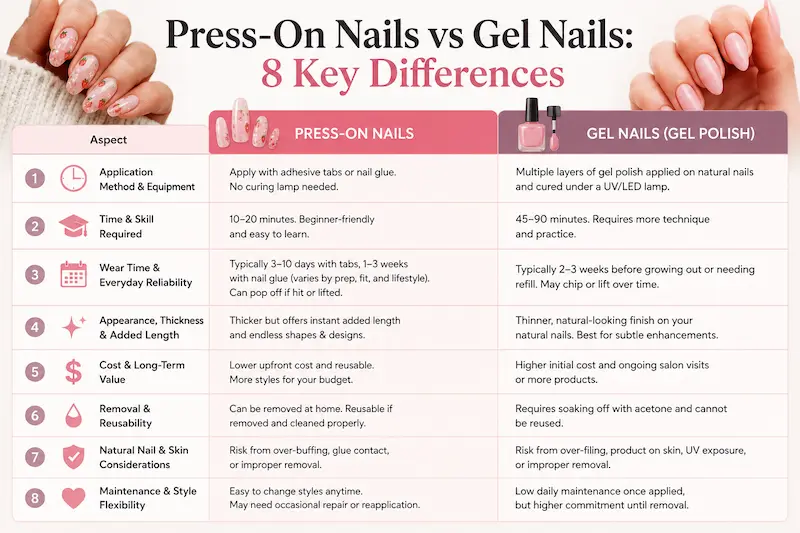
3. Press-On Nails vs Gel Nails: 8 Key Differences
3.1. Application Method and Equipment
Press-on nails arrive pre-shaped and often pre-designed. After you match the sizes and prepare the natural nails, you attach the set with adhesive tabs or nail glue. No curing lamp is needed. For a complete step-by-step process, see how to apply press-on nails correctly.
A gel manicure is built directly on the natural nail with a base coat, one or more color coats, and a top coat. Each layer must be cured under a lamp that is compatible with the gel system.
Press-ons therefore have a lower equipment barrier, while gel offers more control over the exact color and finish during application. Both still require careful preparation: poor sizing affects press-on fit, while poor coating or curing can affect gel retention.
Best for a simpler at-home setup: Press-on nails.
3.2. Time and Skill Required
Press-ons are usually faster because the shape and artwork are already complete. Most of the work involves preparation, sizing, alignment, and attachment.
Gel takes longer because each coat is applied separately and must be cured before the next step. At-home gel also has a steeper learning curve: thick coats, product on the skin, or incorrect curing can lead to uneven results or lifting.
Press-ons are more beginner-friendly, although an accurate fit is still essential for a natural-looking result.
Best when time matters most: Press-on nails.
3.3. Wear Time and Everyday Reliability
Gel polish generally provides more predictable uninterrupted wear because it is cured directly onto the natural nail. Over time, it may chip, lift, or show visible regrowth. Learn more about how long press-on nails last with adhesive tabs versus nail glue.
Press-on wear varies more. Adhesive tabs are usually chosen for short-term wear and easier removal, while nail glue normally creates a stronger bond. Fit, preparation, adhesive contact, nail length, and daily activities all influence the result.
The failure pattern is also different: a press-on may loosen as one complete nail, while gel usually chips or lifts around the edges. An intact press-on may sometimes be reapplied, but gel must be repaired or redone.
Best for predictable continuous wear: Gel nails.
Proper preparation, sizing, and aftercare can also help make press-on nails last longer.
3.4. Appearance, Thickness, and Added Length
Gel polish usually creates the thinner finish because it follows the natural nail. It is a strong choice for short, natural-looking color and a seamless cuticle area.
Press-ons sit over the nail, so the result depends on thickness, curvature, sizing, and placement. A natural-looking result starts with learning how to choose the correct press-on nail size for each finger. A well-fitted set can look salon-finished; an incorrect size may look bulky or leave visible gaps.
The major advantage of press-ons is that they can change both the design and the visible architecture of the nail. They can add length, create a new shape, and deliver finishes such as cat-eye, chrome, or detailed artwork immediately.
Best for instant length and pre-designed art: Press-on nails.
3.5. Cost and Long-Term Value
Press-ons usually have a lower starting cost than repeated professional gel appointments, especially for occasional wear. Some sets may also provide more than one use when they are removed intact and cleaned according to the product instructions.
Professional gel pricing can include application, removal, repairs, and added nail art. At-home gel may become economical over time, but it requires an initial investment in a lamp, base and top coats, colors, and removal supplies.
The best comparison is cost per successful wear, not price alone. Consider how long the manicure remains presentable, whether a salon is required, and whether a press-on set is genuinely reusable. For a deeper breakdown of pricing, craftsmanship, and cost per wear, see our guide on how much press-on nails cost.
Best value for occasional wear and frequent style changes: Press-on nails.
3.6. Removal and Reusability
Adhesive-tab press-ons are generally the easiest to remove and usually offer the best chance of reuse. Glue-on sets require more patience and should be removed according to the adhesive manufacturer’s instructions. Whichever adhesive you use, always remove press-on nails without damage instead of pulling or prying them off.
Gel polish is normally softened with acetone before the remaining product is moved away gently. It cannot be reused after removal. Whether you can reuse press-on nails depends on the adhesive, removal method, and condition of the set.
Neither manicure should be peeled, pried, or forced off. Aggressive removal can strip surface layers from the natural nail, even when the original application looked harmless.
Best for flexible removal and possible reuse: Press-on nails.
3.7. Natural Nail and Skin Considerations
Neither option is automatically damage-free. Read our full guide to learn whether press-on nails are safe and how to reduce avoidable risks during application and removal. Press-on problems are more likely when the nail is over-buffed, glue touches the surrounding skin, an incorrect size is forced into place, or a strongly bonded nail is pulled off.
Gel risks are different. Over-filing, peeling cured gel, repeated solvent exposure, or leaving uncured product on the skin may contribute to irritation or nail damage. Gel lamps also use ultraviolet light; LED lamps generally cure faster and emit lower UV levels than traditional UV curing lamps, but “LED” does not mean zero UV.
The American Academy of Dermatology notes that gel manicures can contribute to brittleness, peeling, and cracking, while the FDA advises consumers to follow nail-product labels and stop using cosmetics that cause an unexpected reaction. Correct application and patient removal matter more than simply labeling one option “healthier.”
Best approach: choose the system you can apply and remove correctly.
3.8. Maintenance and Style Flexibility
Gel usually requires less day-to-day attention because there is no separate full-cover nail that can pop off. The tradeoff is greater commitment to the same color or design until it grows out or is removed.
Press-ons are easier to coordinate with an event, outfit, season, or short-term need. An intact nail may be reapplied, and a full set can be changed without repainting the natural nails.
For hands-on work, shorter nails are generally easier to manage regardless of the system. Long press-ons create more leverage when they catch on objects, while long gel or extension styles can also interfere with daily tasks.
Best for frequent design changes: Press-on nails. Best for low-commitment continuous wear: Gel nails.
4. Press-On Nails vs Gel-X: Are They the Same?
No. They can look similar because both may use full-cover tips, but the attachment system and level of commitment are different.
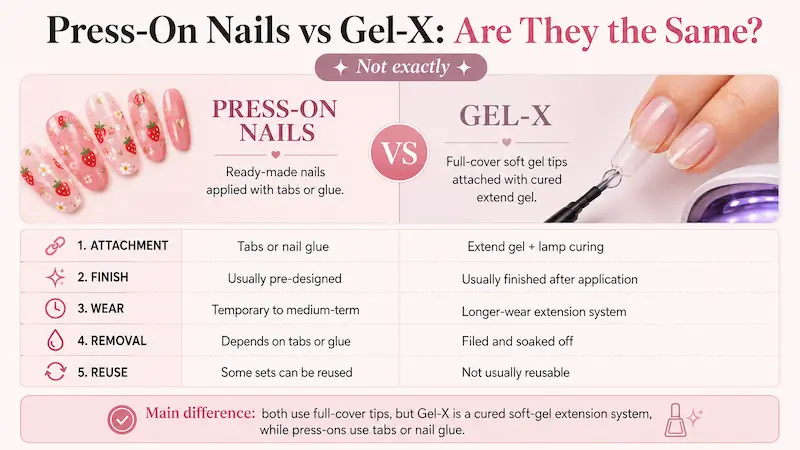
Press-ons are finished artificial nails attached with tabs or traditional nail glue. Gel-X uses full-cover soft-gel tips bonded with a gel product that is cured under a compatible lamp. The Gel-X manufacturer, Aprés Nail, describes the system as a full-coverage soft-gel nail extension system.
| Factor | Press-On Nails | Gel-X |
| Attachment | Adhesive tab or nail glue | Gel adhesive cured under a lamp |
| Design | Usually finished before application | Usually shaped and polished as part of the service |
| Equipment | No curing lamp required | Gel products and compatible lamp required |
| Wear style | Temporary to medium-term depending on adhesive | Longer-wear extension service |
| Removal | Depends on the adhesive used | Usually filed and soaked off as directed |
| Reuse | Sometimes possible | Generally not intended for reuse |
Choose press-ons when speed, flexible removal, pre-designed art, and possible reuse matter most. Choose Gel-X when you want salon-style added length with a cured gel bond and are comfortable with a more involved application and removal process.
5. Which Is Better for Your Lifestyle?
| Situation | Better Starting Choice | Why |
| Wedding, party, or one-day event | Press-ons with tabs | Fast application and easier removal after the event |
| Frequent design changes | Press-ons | The full style can be changed without repainting |
| Continuous multi-week wear | Gel polish | More predictable retention on the natural nail |
| Instant added length | Press-ons or Gel-X | Standard gel polish does not create a full extension |
| No curing lamp | Press-ons | Tabs or nail glue do not require curing |
| Short, natural-looking color | Gel polish | Creates a thin finish directly on the nail |
| Salon-style extensions | Gel-X | Designed as a longer-wear soft-gel extension system |
| Hands-on work | Short gel or short press-ons | Shorter nails reduce leverage and snagging |
Press-ons are the best fit for flexibility. Gel polish is the best fit for consistent wear on natural nails. Gel-X is the best fit when added length and a longer-wear salon extension are the main goals.
6. Final Verdict: Are Press-On Nails Better Than Gel Nails?
Press-on nails are better for speed, instant length, design variety, flexible removal, and possible reuse. Gel polish is better for a thinner finish and more predictable continuous wear on natural nails. Gel-X is the stronger choice when you want a longer-wear extension service rather than a temporary or reusable set.
The right manicure depends on your schedule, preferred look, budget, and willingness to commit to application and removal. Whichever option you choose, careful preparation and gentle removal are more important than claims that one category is always safer or healthier.
7. Frequently Asked Questions
Do press-on nails last as long as gel nails?
Usually not as predictably. Gel polish commonly provides more consistent multi-week wear, while press-on retention varies with tabs or glue, sizing, preparation, nail length, and daily activity. Glue-on sets can last much longer than tab applications, but individual nails may still loosen.
Are press-on nails less damaging than gel nails?
They can be gentler in some situations, especially when temporary tabs are used, but they are not damage-free. Pulling off glued nails can strip the nail surface. Gel can also contribute to damage when the nail is over-filed or the cured product is peeled away. Removal technique is the key variable.
Can press-on nails look as natural as gel nails?
Yes, when the size, curvature, thickness, and cuticle placement match the natural nail. Gel is naturally thinner because it is painted directly onto the nail, while press-ons can create a more uniform shape and instant length.
Is Gel-X the same as press-on nails?
No. Press-ons use tabs or nail glue and are often fully designed before application. Gel-X uses soft-gel tips bonded with a cured gel system and is intended as a longer-wear extension service.
For a closer look at over-buffing, adhesive use, and forced removal, read whether press-on nails can damage natural nails.
Sources and Editorial References
- American Academy of Dermatology – Artificial nails: Tips for reducing nail damage – Guidance on gel curing lamps and reducing nail damage.
- American Academy of Dermatology – Gel manicures: Tips for healthy nails – Information on brittleness, peeling, cracking, and UV exposure.
- American Academy of Dermatology – Removing gel polish at home – Dermatologist guidance on acetone removal and avoiding peeling.
- U.S. Food and Drug Administration – Nail Care Products – General nail-product safety, ingredient, and labeling information.
- Aprés Nail – Why Gel-X? – Manufacturer description of Gel-X as a full-coverage soft-gel extension system.