Press-On Nail Basics
Are Press-On Nails Safe? What to Know Before Wearing Them
Press-on nails are one of the easiest ways to get a polished manicure at home without booking a salon appointment. They are affordable, removable, and available in almost every length, shape, and design.
But if you wear them often, you may wonder: Are press-on nails safe for your natural nails? Can they cause damage, fungus, or allergic reactions?
The short answer is: press-on nails are generally safe for most healthy natural nails when they are applied, worn, and removed correctly. However, they are not completely risk-free. Like any artificial nail product, press-ons can cause problems if they are applied over unhealthy nails, glued too aggressively, worn for too long, or peeled off instead of removed gently.
This guide explains the real safety risks, who should avoid press-ons, how to wear them more safely, and when to remove them immediately.
1. Are Press-On Nails Safe? Quick Answer
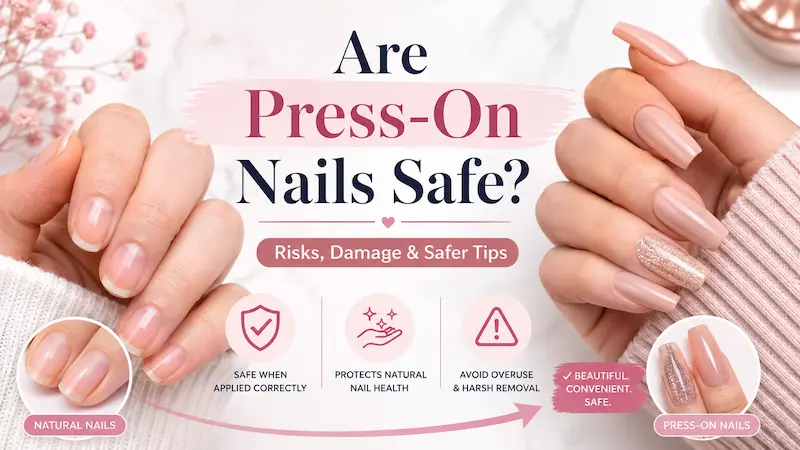
Yes, press-on nails are usually safe for healthy natural nails when you choose the right size, apply them to clean and dry nails, use adhesive carefully, and remove them gently.
Most safety issues do not come from the press-on nail itself. They usually happen because of:
- too much filing or buffing before application
- nail glue touching the skin or cuticles
- moisture getting trapped under a lifted nail
- wearing the same set for too long
- peeling or ripping the nails off
- applying press-ons over weak, painful, infected, or damaged nails
Dermatologists commonly point to three main concerns with artificial or press-on nails: nail damage, infection, and allergic reactions. Cleveland Clinic notes that press-ons can trap moisture, which may create an environment where bacteria or fungus can grow.
A simple way to think about it:
| Press-on nails are safer when… | Press-on nails are riskier when… |
|---|---|
| Your natural nails are healthy | Your nails are peeling, painful, infected, or lifting |
| You choose the right size | The press-ons are too tight, too curved, or too long |
| You use moderate glue or adhesive tabs | Glue touches your skin or cuticles |
| You remove them gently | You peel, rip, or force them off |
| You take breaks between sets | You wear artificial nails continuously |
So, are press-on nails safe? For most people, yes — as long as your natural nails are healthy and you treat press-ons as a temporary manicure, not something to force onto damaged nails.
2. The Main Safety Risks of Press-On Nails
Press-on nails are convenient, but they still sit on top of your natural nails and rely on adhesive. That means there are a few risks worth understanding before you wear them regularly.
2.1. Nail damage
Press-on nails can damage natural nails when they are applied or removed incorrectly. The most common signs include:
- peeling
- thinning
- rough white patches
- splitting
- dryness
- sensitivity
- weak or bendy nails
This type of damage is usually linked to harsh prep or rough removal. Light buffing may help adhesive stick, but aggressive buffing can thin the nail plate. Peeling off press-ons can also pull away layers of the natural nail.
The safest approach is to prep gently, avoid overusing glue, and never rip off a press-on nail.
For a deeper explanation of this topic, read our guide on can press-on nails damage natural nails.
2.2. Infection or fungus
Press-on nails may increase the risk of infection if moisture becomes trapped between the artificial nail and your natural nail. This is more likely when a nail lifts, does not fit properly, or is worn too long.
A lifted press-on can create a small gap where water, dirt, and bacteria may collect. If the area stays damp, it can become a problem.
Remove the press-on and stop wearing artificial nails if you notice:
- green, yellow, white, brown, or dark discoloration
- a bad smell
- pain or throbbing
- swelling
- pus or fluid
- warmth around the nail
- the natural nail lifting from the nail bed
Do not cover a suspicious nail with another press-on. If symptoms continue or look infected, ask a dermatologist or healthcare professional for advice.
2.3. Allergic reactions
Some people can react to nail glue, adhesive tabs, gel products, or ingredients used in nail cosmetics. A reaction may appear around the nails, but it can also show up on skin you touch after handling the product.
Possible signs include:
- itching
- redness
- swelling
- rash
- burning
- tenderness
- peeling skin
- small blisters
DermNet notes that press-on and pre-glued artificial nails often use acrylic glues, and some glue ingredients may cause allergic contact dermatitis in sensitive people. The FDA also states that infections and allergic reactions can occur with some nail products.
To lower the risk, keep glue away from your skin and cuticles, follow product directions, and stop using a product if you notice irritation.
2.4. Pressure or nail separation
A press-on nail should feel secure, not painful. If the nail is too small, too curved, too long, or too rigid for your natural nail shape, it may create pressure.
Pressure can make the nail feel pinched, sore, or uncomfortable. In some cases, trauma, irritation, or adhesive reactions may contribute to nail lifting or separation.
Remove the set if a nail feels painful, tight, or throbbing. A little awareness of new length is normal. Pain is not.
3. Who Should Avoid Press-On Nails?
Press-on nails are not the best choice for everyone. If your natural nails or the skin around them are already irritated, damaged, painful, or infected, it is safer to wait before applying anything on top.
You should avoid press-on nails, or at least take a break, if you have:
- a current nail infection
- painful, swollen, or bleeding skin around the nail
- green, yellow, brown, white, or dark nail discoloration
- natural nails lifting from the nail bed
- very thin, peeling, splitting, or brittle nails
- a known allergy to nail glue, acrylates, or methacrylates
- cracked, inflamed, or freshly cut cuticles
- a job or activity where long artificial nails may be unsafe or unhygienic
- a habit of picking, peeling, or ripping off artificial nails
Press-ons should enhance your manicure, not hide a nail problem. If your nails hurt, look infected, or seem unusually weak, give them time to recover first.
In general, press-on nails are safest when your natural nails are healthy, dry, comfortable, and free from infection or irritation.
4. Are Press-On Nails Safer Than Acrylic or Gel Nails?
Press-on nails can be a gentler option than acrylic or gel nails for many people, especially when they are worn short-term and removed carefully.
The main reason is that traditional press-ons usually do not require heavy salon filing, acrylic liquid and powder, or UV/LED curing. They can also be removed at home more easily than many salon enhancements.
However, “safer” does not mean “risk-free.”
| Nail option | Main safety concern | Often best for |
|---|---|---|
| Press-ons with adhesive tabs | May lift sooner, shorter wear | Short events, beginners, sensitive nails |
| Press-ons with nail glue | Removal damage, glue irritation, allergic reactions | Longer wear, stronger hold |
| Gel nails | Removal damage, curing process, possible allergies | Glossy salon-style manicures |
| Acrylic nails | Filing, strong chemicals, removal stress | Long-lasting extensions |
For occasional wear, press-ons are often one of the more flexible artificial nail options. You can choose adhesive tabs for a gentler temporary manicure or glue for longer wear.
For a fuller comparison, read our guides on press-on nails vs acrylic nails and press-on nails vs gel nails.
5. Are “Non-Toxic” or Vegan Press-On Nails Safer?
“Non-toxic,” “vegan,” and “cruelty-free” press-on nails can be good signs, but they do not automatically mean the product is safe for every person.
These labels usually describe the brand’s ingredient choices, ethical standards, or manufacturing claims. They may help you avoid certain ingredients or animal-derived materials, but they do not guarantee that you cannot get irritation, an allergic reaction, nail damage, or infection.
For press-on nails, safety usually depends on three things:
- the press-on nail material
- the adhesive or glue used
- how the nails are applied, worn, and removed
A press-on set may be labeled vegan or non-toxic, but if the glue irritates your skin, the nail is the wrong size, or you peel it off aggressively, your natural nails can still become damaged.
“Non-toxic” is also not the same as “allergy-proof.” Some people can react to ingredients that are safe for most users. “Vegan” usually means the product avoids animal-derived ingredients, while “cruelty-free” usually refers to animal testing policies. Both can be useful ethical claims, but they are not direct nail-health guarantees.
A better way to evaluate a safer press-on nail set is to check whether the brand lists ingredients clearly, provides application and removal instructions, and includes warnings for glue or adhesive use.
Be careful with broad claims like “100% safe,” “chemical-free,” or “impossible to damage your nails.” Even gentle products can cause problems if they are used incorrectly or if you are sensitive to an ingredient.
6. Glue vs Adhesive Tabs: Which Is Safer?
Both nail glue and adhesive tabs can be safe when used correctly. The safer choice depends on your natural nail condition, how long you want the press-ons to last, and how gentle you need the removal process to be.
For beginners, sensitive nails, or short-term wear, adhesive tabs are usually the gentler option. They create a lighter bond and are typically easier to remove.
For longer wear, nail glue usually gives a stronger hold, but it also requires more careful application and removal.
| Your situation | Better option |
|---|---|
| You want one-day wear | Adhesive tabs |
| You are new to press-ons | Adhesive tabs |
| Your nails are weak or recovering | Adhesive tabs or take a break |
| You want longer wear | Nail glue |
| You have sensitive skin | Adhesive tabs may be better |
| You have reacted to nail glue before | Avoid glue and consider professional advice |
| You tend to peel nails off | Adhesive tabs are safer |
If your priority is maximum hold, glue is usually better.
If your priority is easier removal and lower damage risk, tabs are usually better.
For more detailed product guidance, read our guide to the best nail glue for press-on nails.
7. How to Wear Press-On Nails More Safely
The safest way to wear press-on nails is to treat them as a temporary manicure and protect your natural nails before, during, and after each set.
Here are the most important safety habits:
- Start with healthy nails. Do not apply press-ons over painful, swollen, discolored, infected, or lifting nails.
- Keep nails clean and dry before application. Moisture and oils can weaken the bond and increase lifting.
- Choose the right size. A press-on should fit from sidewall to sidewall without pressing into the skin.
- Avoid over-buffing. Light prep is enough. Do not thin the natural nail plate.
- Keep glue off your skin and cuticles. Use a small amount and apply it only to the nail plate.
- Choose shorter lengths if you are worried about lifting. Short or medium press-ons put less pressure on the natural nail.
- Take breaks between sets. Check your natural nails for dryness, peeling, discoloration, or sensitivity before reapplying.
- Remove them gently. Never peel, rip, or pry press-ons off.
- Moisturize after removal. Cuticle oil or hand cream can help reduce dryness around the nail area.
For a full step-by-step routine, read our guide on how to apply press-on nails.
8. When Should You Remove Press-On Nails Immediately?
Press-on nails should feel comfortable. They may feel different at first because of the added length or shape, but they should not cause pain, burning, throbbing, or pressure.
Remove your press-ons gently if you notice any of the following:
| Remove them if you notice… | Why it matters |
|---|---|
| Pain or throbbing | May indicate poor fit, pressure, or nail trauma |
| Redness, swelling, or warmth | Possible irritation or infection |
| Itching, rash, burning, or blisters | Possible allergic reaction |
| Green, yellow, white, brown, or dark discoloration | Possible infection, trapped moisture, or nail changes |
| Pus, fluid, or bad smell | May need professional attention |
| A press-on lifting badly | Water and debris can get trapped underneath |
| Natural nail lifting from the nail bed | Do not cover it with another press-on |
Do not try to hide these signs with a new set. Remove the press-on, keep the nail clean and dry, and avoid reapplying until the nail looks and feels normal.
If symptoms persist, worsen, or look infected, ask a dermatologist or healthcare professional for advice.
For detailed removal tips, read our guide on how to remove press-on nails without damage.
9. Final Verdict: Are Press-On Nails Safe?
Press-on nails are generally safe for most people with healthy natural nails when they are applied correctly, worn for a reasonable amount of time, and removed gently.
They can become bad for your nails when you apply them over damaged nails, use too much glue, let glue touch the skin, wear lifted nails for too long, ignore pain or discoloration, or peel them off.
The safest approach is simple: start with healthy nails, choose the right size, use adhesive carefully, avoid continuous wear, and remove press-ons with patience.
Press-on nails can be part of a safe beauty routine — as long as your natural nails come first.
10. FAQs About Press-On Nail Safety
Are press-on nails bad for your nails?
Press-on nails are not automatically bad for your nails. They are usually safe for healthy natural nails when applied and removed correctly. They become riskier when you over-buff, use too much glue, wear lifted nails too long, or peel them off.
Are press-on nails safer than acrylic nails?
Press-on nails can be gentler than acrylic nails because they usually do not require heavy salon filing, acrylic liquid and powder, or long-term fill-ins. However, press-ons can still damage nails if they are glued on poorly or removed aggressively.
Can press-on nails cause fungus?
Press-on nails may increase the risk of infection or fungus if moisture gets trapped underneath a lifted nail. If you notice discoloration, bad smell, swelling, pain, pus, or nail lifting, remove the press-on and do not cover the nail with another artificial nail.
Is nail glue safe for press-on nails?
Nail glue can be safe when used as directed. Use only a small amount, keep it on the nail plate, and avoid getting glue on your skin or cuticles. Stop using the product if you notice itching, redness, swelling, burning, or rash.
Are adhesive tabs safer than nail glue?
Adhesive tabs are often gentler than nail glue because they create a lighter bond and are usually easier to remove. Nail glue usually lasts longer, but it also creates a stronger hold, so removal needs more patience.
Are non-toxic press-on nails really safer?
Non-toxic press-on nails may be a better choice when the brand lists ingredients clearly and avoids certain harsh ingredients. However, “non-toxic” does not mean allergy-proof, damage-proof, or safe for every person. Proper application and removal still matter.
Sources and Editorial References
This article is for general nail-care education and should not replace medical advice from a dermatologist or healthcare professional.
Editorial references used:
- Cleveland Clinic: press-on nail risks, including infection, allergic reactions, and nail damage.
- American Academy of Dermatology: artificial nail damage, nail recovery, and nail changes that may need professional attention.
- FDA: nail product safety, label warnings, infections, allergic reactions, and reporting unexpected cosmetic reactions.
- DermNet: nail cosmetics allergy, acrylates, allergic contact dermatitis, and nail separation.