Buying Guides & Comparisons
Nail Glue vs Adhesive Tabs for Press-On Nails: Which Should You Use?
Choosing between nail glue and adhesive tabs affects more than how firmly a press-on set stays attached. It also changes how easy the nails are to position, when they can be removed, and how much cleanup may be needed before reuse. This comparison focuses on those practical trade-offs. For broader guidance on choosing, wearing, and caring for press-ons, start with our complete guide to press-on nails.
Quick answer: Choose nail glue when secure, planned multi-day wear matters most. Choose adhesive tabs for short wear, trial wear, easier removal, frequent design changes, or simpler reuse. Neither option guarantees a fixed wear time; fit, preparation, water exposure, activity, and the adhesive product all affect the result.
1. Nail Glue vs Adhesive Tabs at a Glance
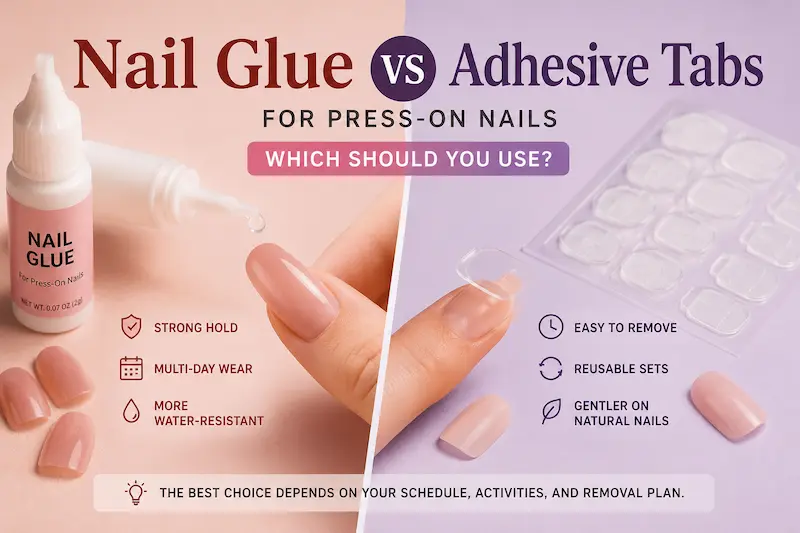
| Factor | Adhesive tabs | Nail glue |
| Best suited for | Short wear, events, trial wear | Planned multi-day wear |
| Holding potential | Lighter and easier to reverse | Generally stronger |
| Repositioning | More forgiving during placement | Less forgiving after contact |
| Removal | Usually faster and simpler | Usually requires more time |
| Reuse | Often leaves less cured residue | Possible, but cleanup may be needed |
| Water and activity | More likely to loosen | Usually the more secure starting option |
| Main trade-off | Shorter or less predictable wear | More removal responsibility |
These are general differences, not guarantees. A stronger adhesive cannot fully compensate for a press-on that is the wrong width or does not match the curve of the natural nail.
2. What Is the Difference Between Nail Glue and Adhesive Tabs?
Nail glue is a liquid adhesive that bonds the natural nail to the underside of the press-on. Adhesive tabs—also called sticky tabs or jelly tabs—are pre-cut pieces of double-sided adhesive placed between the two surfaces. Both methods can work well, but they are designed around different priorities.
2.1. How Nail Glue Works
Nail glue spreads across the contact area and normally creates the stronger attachment. It is the usual starting point when someone wants one set to remain in place through several days of work, travel, or daily activity. Its main trade-offs are limited repositioning time, possible overflow if too much is used, and cured residue after removal. Glue formulas and applicators also differ, so the best nail glue for press-on nails depends on the wear goal and how much application control the user needs.
2.2. How Adhesive Tabs Work
Tabs create a removable adhesive layer rather than a liquid bond. They are often easier for first-time wearers because the tab size and press-on position can be checked before full pressure is applied. They are especially useful for an evening event, testing an unfamiliar length, changing designs frequently, or preserving a handmade set for another wear. Tab thickness, flexibility, and adhesive quality vary, and a tab that is too small or overlaps the skin may lift early.
3. Nail Glue vs Adhesive Tabs: 6 Key Differences
3.1. Hold Strength and Intended Wear
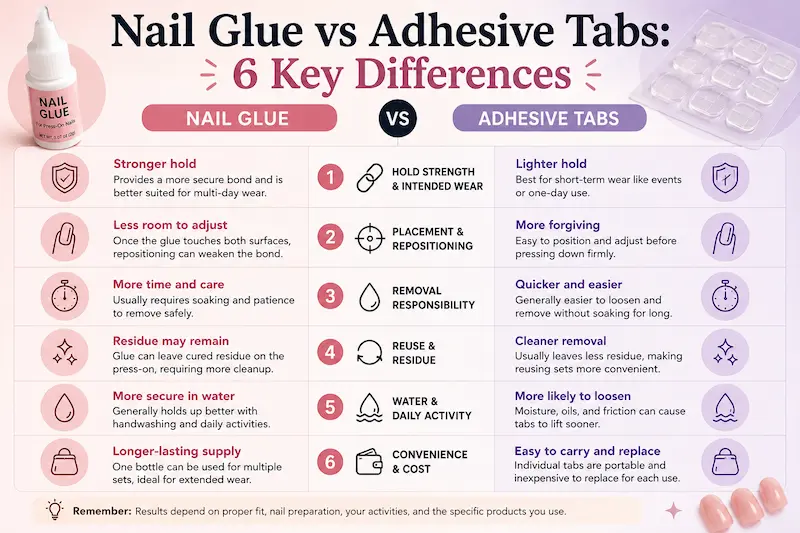
Nail glue generally has greater holding potential, while tabs prioritize flexibility and easier release. That distinction is more useful than promising a universal number of wear days. Retention also depends on fit, nail-plate preparation, natural oils, daily activity, water exposure, and the specific product. Manufacturer wear claims should therefore be treated as product-specific estimates. For a full explanation of these variables, see how long press-on nails last.
3.2. Placement and Repositioning
Tabs are normally more forgiving during placement. The wearer can center the tab, remove its film, and check the press-on angle before applying full pressure. Glue requires more control because repeatedly lifting a tip after the glued surfaces meet can disturb the adhesive layer. This does not make glue unsuitable for beginners, but it makes pre-sizing and arranging the nails before application more important.
3.3. Removal Responsibility
Tabs are generally easier and faster to loosen. Glue normally requires a more deliberate removal process and more patience. With either method, resistance means the adhesive has not loosened enough—do not pull or pry the press-on away. Forceful removal can strip surface layers from the natural nail. Follow the product instructions and use the complete guide to remove press-on nails without damage when a nail still feels firmly bonded.
3.4. Reuse and Residue
Tabs usually leave less cured residue on the underside, which can make them more convenient when reuse is the main priority. Glue-on press-ons may also be reusable, provided the tips remain intact and the residue can be reduced without damaging the structure or artwork. The attachment method matters, but careful removal matters just as much. Our guide to reusing press-on nails safely covers cleaning and storage in more detail.
3.5. Water Exposure and Daily Activity
Glue is generally the more secure starting option when repeated handwashing, household tasks, or several consecutive days of wear are expected. However, neither method should be described as completely waterproof. Existing gaps, poor fit, soaking, and repeated pressure can weaken either attachment. For water-specific precautions, see our guide to showering with press-on nails.
3.6. Convenience, Cost, and Portability
Tabs are easy to carry for quick style changes, and there is no liquid bottle that can leak in a bag. Each reapplication, however, requires a fresh tab. One bottle of glue may support several applications, but it must be stored securely and the opening can become difficult to use if product dries around the cap. For travel, the better choice depends on whether the priority is keeping one set on or changing and removing the set easily.
4. Which Should You Choose?
The most useful decision is based on the complete wear schedule—not simply on which method sounds stronger. Decide when the set needs to come off, how active the wearer will be, and whether the same set should be reused.
| Situation | Better starting option | Why |
| Dinner, photos, or a one-night event | Adhesive tabs | Easier planned removal |
| First trial of a new length or shape | Adhesive tabs | Tests fit and comfort |
| Weekend plans | Tabs or glue | Depends on activity and removal timing |
| Several office or school days | Nail glue | More secure multi-day starting point |
| Vacation or travel | Nail glue | Less need for planned reapplication |
| Frequent design changes | Adhesive tabs | Simpler switching |
| Reuse is the main priority | Adhesive tabs | Usually less underside residue |
| Sizing is still uncertain | Adhesive tabs first | Lower-commitment fit test |
4.1. Choose Tabs When Flexibility Matters Most
Tabs make sense when the manicure must come off on a predictable schedule, the wearer changes styles frequently, or a new length needs to be tested before a longer commitment. They are also the more practical starting point when preserving a handmade set matters more than maximum hold.
4.2. Choose Glue When Multi-Day Security Matters Most
Glue is usually more suitable when one confirmed, well-fitting set needs to remain in place through several days of normal activity. It is often the better starting option for a workweek, travel itinerary, or multi-day event, provided the wearer also has time for careful removal afterward.
5. Can You Use Nail Glue and Adhesive Tabs Together?
Some wearers place a tab on the natural nail and add a small amount of glue between the tab and the press-on. This hybrid approach is not automatically the best of both methods. It may make removal less predictable, leave both tab and glue residue, reduce the easy-reuse advantage of tabs, or create uneven thickness beneath the tip.
Beginners are usually better served by learning one attachment method at a time. Only combine products when the instructions for the specific press-ons, tabs, and glue allow it. A hybrid application should not be described as damage-free or as a guarantee of a particular wear time.
6. What Both Methods Still Require
Whichever method you choose, confirm the size and curvature of every press-on before exposing a tab or opening the glue. Start with clean, fully dry nails, keep adhesive away from the surrounding skin, and follow the directions for the specific product. Preparation affects both methods, but it does not change their main trade-off: glue prioritizes stronger multi-day attachment, while tabs prioritize flexibility and easier removal. For the full preparation and placement sequence, follow our guide to applying press-on nails correctly.
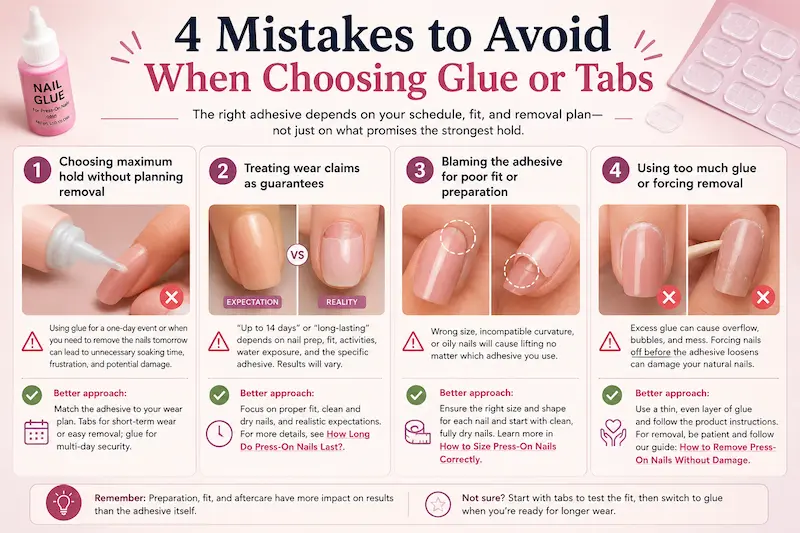
7. 4 Mistakes to Avoid When Choosing Glue or Tabs
7.1. Choosing Maximum Hold Without Planning Removal
The strongest available bond is not always the most practical choice. A manicure that must come off the next morning does not need the same attachment plan as a week of travel. Choose the removal schedule before choosing the adhesive.
7.2. Treating Wear-Time Claims as Guarantees
Adhesive brands may publish estimated wear periods, but actual results vary with fit, preparation, water, activity, and application technique. Use those figures as product guidance rather than a promise that every wearer will get the same result.
7.3. Blaming the Adhesive for Poor Fit or Preparation
A tip that is too narrow may lift at the sidewalls, while the wrong curvature can leave unsupported space beneath the press-on. Oil, moisture, or residue on the nail plate can also weaken either adhesive. Stronger glue may temporarily hide a fit problem without fixing it. Check our guide to sizing press-on nails correctly before switching adhesives.
7.4. Using Excess Glue or Forcing Removal
More glue does not automatically create better retention. Excess product can spread onto the surrounding skin, increase residue, and complicate removal. At the other end of the wear cycle, pain or resistance is a reason to stop—not to pull harder. Follow the adhesive label and discontinue use if unexpected irritation occurs.
Final Verdict: Is Nail Glue or Adhesive Tabs Better?
Nail glue is generally better when the priority is stronger, planned multi-day wear. Adhesive tabs are generally better when the priority is short wear, easier removal, trial wear, frequent changes, or convenient reuse. Before applying a set, answer two questions: How long does it realistically need to stay on, and how will it be removed? The best attachment method is the one that fits both parts of that plan.
Frequently Asked Questions
Are adhesive tabs better for reusable press-on nails?
They are often more convenient for reuse because they usually leave less cured residue on the underside. Reuse still depends on careful removal and whether the press-ons remain straight, intact, and free from damaged decorations.
Can adhesive tabs last for a week?
Some products may remain secure for several days under favorable conditions, but a full week should not be assumed. Tab quality, correct sizing, preparation, handwashing, water exposure, and daily activity all affect retention.
Is nail glue waterproof?
Nail glue is generally more resistant to everyday water exposure than tabs, but it should not be described as completely waterproof. Soaking, gaps, lifting, and repeated mechanical pressure can still weaken the attachment.
Which option is better for beginners?
Tabs are often the more forgiving starting point because there is no liquid glue to control and the wearer can test placement, size, and comfort with less commitment. Glue becomes useful when longer wear is needed and placement is already familiar.
Can you reuse press-on nails after using glue?
Yes, some glue-on press-ons can be reused if they are removed without bending or cracking and the underside can be cleaned without weakening the tip or damaging the design.
Can I apply glue over an old adhesive tab?
Remove the old tab and clean both surfaces first. Applying glue over used adhesive can create uneven contact, trap residue, and produce an unpredictable bond.
Editorial Disclosure
Hana Nail designs and sells handmade press-on nails. This guide compares attachment methods using practical criteria: intended wear, placement control, removal responsibility, residue, reuse, and suitability for different schedules. It does not present Hana Nail as an independent reviewer of its own products, and it does not claim that one method is universally best for every wearer.
Sources and Editorial References
- U.S. Food and Drug Administration — Nail Care Products. General guidance to follow labeled directions and warnings for nail-care products.
- National Capital Poison Center — Super Glue. Safety guidance for cyanoacrylate bonding, including avoiding forceful separation.
- KISS — How to Apply Fake Nails at Home. Manufacturer guidance for thin, even glue application and adhesive-tab placement.
- KISS — How Can I Make Them Last Longer?. Manufacturer guidance illustrating that application instructions vary by attachment method.
- Byrdie — Press-On Nails 101. Editorial overview of temporary tab wear, glue application, removal, and reuse.