Buying Guides & Comparisons
Best Handmade Press-On Nails: 7 Signs of Quality Craftsmanship
Handmade press-on nails can offer detailed artwork, distinctive finishes, and more sizing flexibility than many mass-produced sets. Yet the word “handmade” does not automatically guarantee a comfortable fit or careful finishing.
Two sets may look equally impressive in a product photo but feel very different once applied. One may have clean edges, balanced structure, and securely sealed decoration. Another may feel bulky, catch on clothing, or reveal uneven workmanship when viewed from the side.
This buying guide explains how to judge handmade press-on nails as both wearable products and miniature pieces of nail art. The goal is not to name one universally perfect set. It is to help you recognize the craftsmanship, fit, and seller transparency that make a set worth considering.
Editorial disclosure: Hana Nail designs and sells handmade press-on nails. This guide is based on practical product-evaluation criteria and does not present Hana Nail as an independent reviewer of its own products. Brand examples are identified as such.
1. What Makes Handmade Press-On Nails High Quality?
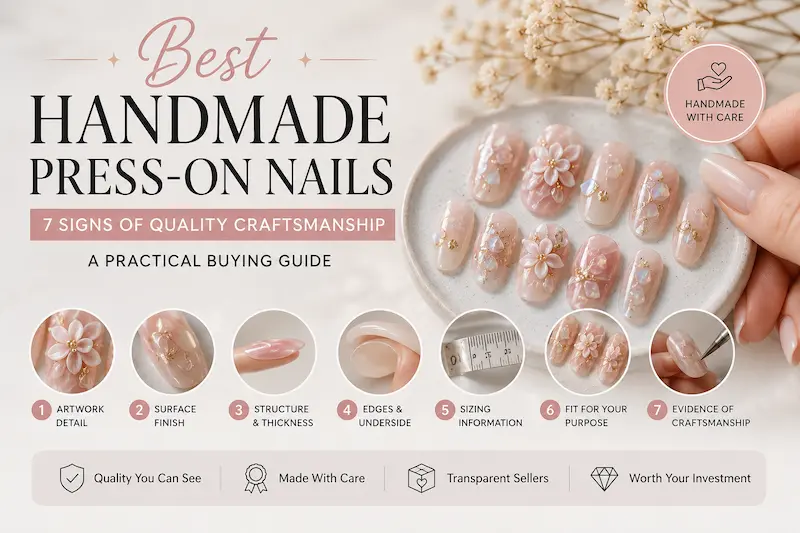
The best handmade press-on nails combine clean artwork, balanced construction, accurate sizing, a controlled finish, and a design that works for the wearer’s actual routine. Complexity alone is not a quality measure. A simple hand-painted set can show excellent craftsmanship, while an elaborate set may disappoint if its edges are rough or its decorations are poorly secured.
A useful way to judge a set is to separate visual appeal from functional quality. Ask not only whether the design is beautiful, but also whether the nail is well finished, wearable, and supported by clear product information.
| Look for | Be cautious of |
| Clear close-up and side-profile photos | Images that hide thickness, edges, or decoration height |
| Clean lines and deliberate placement | Smudged, crooked, or inconsistent details |
| Smooth, sealed decoration | Bubbles, dust, rough transitions, or loose pieces |
| Measurements and shape information | Generic sizing with no explanation |
| Original product or process images | The same unexplained images across unrelated stores |
| Honest wear guidance | Claims that every design suits every lifestyle |
2. What Does “Handmade” Actually Mean?
Many handmade nail artists begin with preformed tips. The maker then paints, layers, embellishes, shapes, or finishes those tips by hand. The blank tip itself does not need to be manufactured from scratch for the finished set to involve genuine handmade work.
The term can also describe different levels of personalization:
- Hand-painted: artwork is created directly on the nail surface.
- Hand-decorated or hand-assembled: charms, stones, pearls, shells, chrome, or sculpted elements are placed individually.
- Made to order: the set is produced after purchase, usually from an existing design.
- Custom-sized: the set is prepared around the customer’s measurements.
- Custom-designed: colors, motifs, or composition are developed around a personal request.
These categories can overlap. A set may be hand-painted, made to order, and custom-sized at the same time. A trustworthy listing should explain what is completed by hand instead of relying on “handmade” as an unexplained marketing phrase.
Small variations can be normal in hand-painted or marbled work. They become a quality problem when they affect the intended design or wearability. Smudging, unsealed decoration, mismatched nail pairs, sharp edges, and loose charms are workmanship issues, not simply natural handmade variation.
3. 7 Signs of Quality Craftsmanship
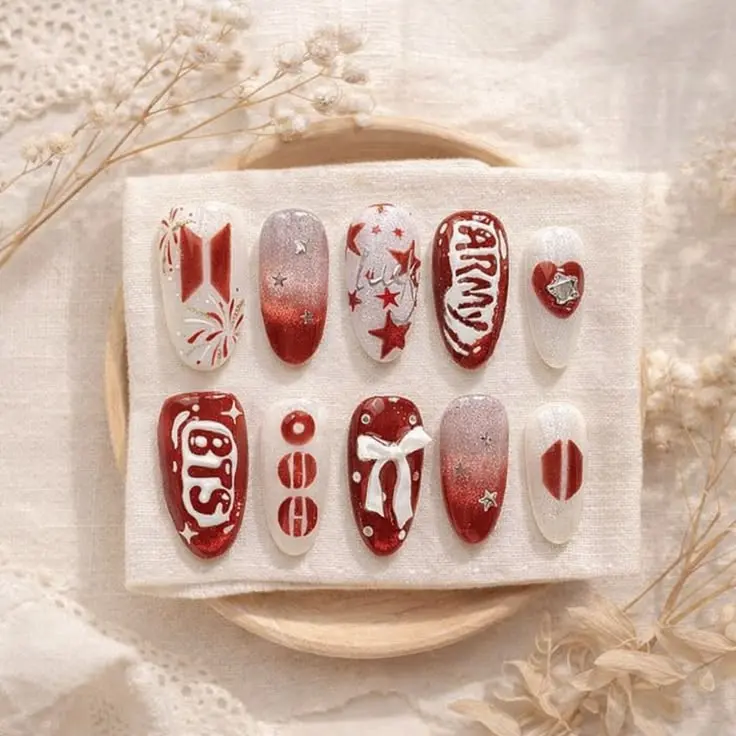
3.1. The Artwork Looks Intentional at Close Range
A distant product photo can make almost any design look polished. A close-up reveals much more about control, consistency, and composition. Look for clean painted lines, deliberate placement, and a balanced relationship among all ten nails.
- Repeated motifs are reasonably consistent.
- Colors meet cleanly without obvious bleeding.
- Symmetrical details align when symmetry is part of the design.
- Focal elements sit in deliberate positions.
- The ten nails feel like one coordinated set rather than unrelated designs.
Abstract, marbled, stone-inspired, and organic artwork does not need to be identical from nail to nail. The relevant question is whether the variation looks purposeful rather than accidental.
3.2. The Surface Is Smooth and Properly Sealed
Glossy finishes should appear even and reflective rather than cloudy or rippled. Matte finishes should look consistently soft instead of patchy. Examine the surface for trapped dust, bubbles, scratches, pooling around decoration, or rough transitions between flat and raised elements.
Three-dimensional artwork will naturally create texture. A sculpted flower is not supposed to be flat. Its edges should still look finished, and the element should appear securely integrated with the base rather than loosely attached. Good finishing protects the artwork while making the design feel complete.
3.3. The Structure Is Balanced, Not Simply Thick
Thickness alone is not a reliable sign of quality. A nail that is too thin for its length may flex or feel unstable. A nail that is unnecessarily thick can look bulky near the cuticle and feel heavy during wear.
Structure should match the design. Short, flat-art sets may need less bulk, while longer shapes and heavily decorated nails require more support. The cuticle area should remain refined enough to blend with the natural nail. Side-profile photos are especially useful because front-facing images can hide bulk or an abrupt cuticle edge.
3.4. The Edges and Underside Look Clean
The underside is rarely the most glamorous part of a listing, but it can reveal how carefully the set was finished. Check the cuticle edge, side edges, free edge, and the area beneath raised decoration.
Large amounts of cured product should not spill beneath the tip, and the edges should not look jagged or sharp. Some light filing may be useful for personal fit, but a buyer should not need to repair poor finishing before wearing a new set. A clean cuticle edge also helps the press-on sit closer to the natural nail. For the sizing, placement, and adhesive details that make this transition look less visible, see our guide on how to make press-on nails look natural.
3.5. The Seller Provides Useful Sizing Information
Beautiful artwork cannot compensate for a poor fit. A well-sized press-on should cover the natural nail without overlapping the surrounding skin, pinching the sidewalls, or rocking before adhesive is applied.
Look for nail widths in millimeters, shape and length information, and a clear route for customers whose measurements do not match a standard set. Width and curvature are separate factors, so two tips with the same stated width may still sit differently on the nail.
For step-by-step measuring instructions and guidance for customers between sizes, use the press-on nail sizing guide rather than estimating from product photos.
3.6. The Design Fits Its Intended Use
A beautifully made set can still be the wrong purchase for a particular routine. Shorter shapes, smooth surfaces, and securely placed accents are generally easier for frequent typing and hands-on tasks. Large bows, clustered stones, and sculptural flowers create stronger visual impact but may catch on hair, knitwear, or pockets.
This trade-off does not make raised artwork poorly designed. It means the buyer should match the surface profile and length to the occasion. Someone buying a first set may prefer flatter artwork, while an experienced wearer may be comfortable adapting to more dramatic decoration.
3.7. The Seller Shows Evidence of the Making Process
A seller does not need to reveal every technique, but transparent information helps buyers understand what they are paying for. Useful evidence may include workspace images, nails shown during production, original sketches, close-ups from multiple angles, material descriptions, realistic production information, customer photos, and clear contact and replacement policies.
No single image proves that every listing is handmade. The goal is to assess the seller’s overall pattern of transparency. Original imagery, consistent product descriptions, and a clear explanation of what is done by hand together create a more trustworthy buying experience.
4. Handmade vs. Mass-Produced Press-On Nails
Neither production method is automatically superior. The better option depends on budget, timing, personalization, and the quality evidence available for the individual product.
| Factor | Handmade press-on nails | Mass-produced press-on nails |
| Design | Painted, layered, or assembled individually | Printed or repeated at scale |
| Variation | Small natural differences may occur | Usually more uniform |
| Personalization | May offer custom sizing or design | Usually standard options |
| Availability | May require production time | Often ready to ship |
| Price | Commonly higher | Commonly lower |
| Best suited to | Distinctive art and personalization | Convenience and lower-cost experimentation |
Mass-produced nails can be comfortable, attractive, and practical. Handmade nails can be disappointing when their artwork, finishing, or sizing is poor. The label matters less than the finished product and the evidence that supports the seller’s claims.
5. Match the Craftsmanship to Your Use Case
The same craftsmanship criteria apply across styles, but the feature you prioritize should change with the way you plan to wear the set.
| Use case | Craftsmanship feature to prioritize |
| Everyday wear | Smooth profile, manageable length, sealed flat art, and clean edges |
| Typing and office work | Compact shape, refined free edge, and minimal raised decoration |
| Weddings and events | Cohesive ten-nail composition, photo-ready finish, and verified sizing |
| Statement wear | Secure 3D elements, balanced support, and clear photos of decoration height |
For more specific recommendations, compare beginner-friendly press-on nails, office-friendly press-on nails, and wedding press-on nails according to your routine or event.
6. When Is the Higher Price Justified?
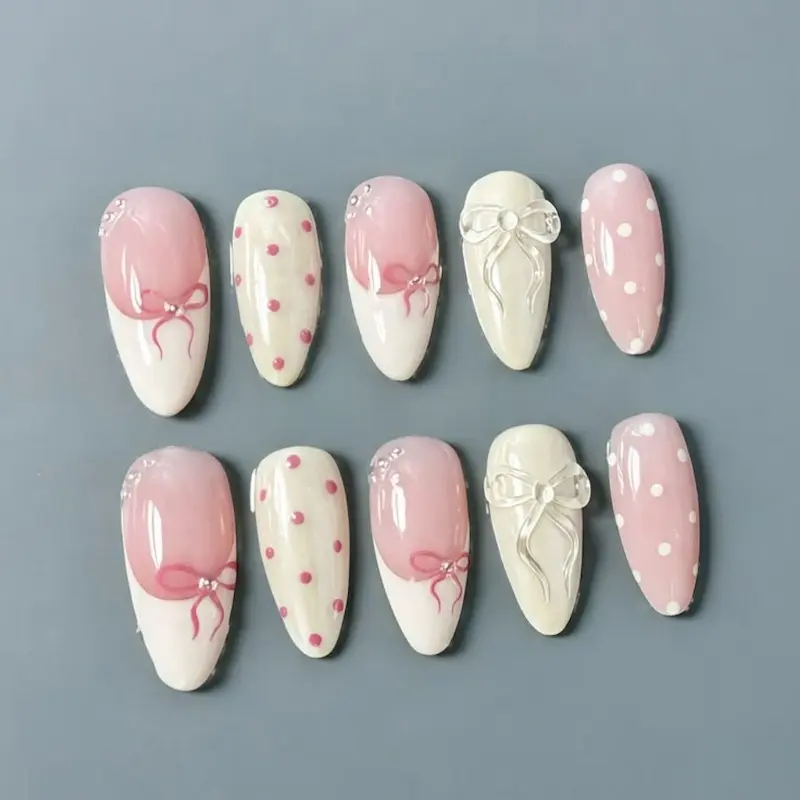
A higher price can be reasonable when it reflects visible work and a better buying experience. Relevant price drivers include original design planning, hand painting, layered effects, sculpting, individual decoration placement, custom sizing, controlled finishing, and careful inspection.
Price alone does not prove quality. Compare the technique visible in close-up photos, the clarity of the sizing information, the condition of the edges, and the level of customer support. A complex design with weak finishing is not automatically better value than a simpler set made with more control.
For a broader comparison of initial price, salon alternatives, and cost per wear, see Are Press-On Nails Worth It?. A well-constructed set may be reusable, but successful reuse depends heavily on adhesive, removal, and cleaning. The guide to reusing press-on nails covers that process in detail.
7. Red Flags When Shopping for Handmade Press-On Nails
7.1. The Same Photos Appear Across Unrelated Stores
A reverse image search can help determine whether a product photo appears elsewhere. A repeated image is not automatic proof of wrongdoing because authorized retail or licensed photography may explain it. Still, the seller should be able to clarify whether the design is made by the business and provide original product or process evidence.
7.2. The Listing Never Explains What Is Handmade
Be cautious when a description repeatedly uses words such as “artisan,” “premium,” or “100% handmade” without explaining whether the set is painted, decorated, made to order, or customized. Vague adjectives do not replace useful product information.
7.3. The Photos Hide Important Angles
Only showing front-facing, highly edited images can conceal the cuticle profile, free edge, overall thickness, and height of raised decoration. Look for at least one close-up and one view that shows the side profile.
7.4. Sizing, Contact, or Order Policies Are Difficult to Find
Even a well-made set can arrive with a sizing concern or shipping problem. A seller should make size guidance, contact details, production and shipping expectations, and replacement or return terms reasonably easy to locate. These details are part of product trust, not optional extras.
8. What Hana Nail Shows About Its Handmade Process
Hana Nail identifies its catalog as handcrafted and provides standard sizing routes alongside custom options. Its size information is intended to help shoppers compare their measurements with available sets instead of choosing only by appearance.
For personalized work, the custom press-on nail service allows customers to submit an idea or reference, choose a shape and size, and review the proposed direction before the set is produced. Because the work is completed by hand, small visual differences may occur between a reference and the finished set.
These details help explain the ordering route, but shoppers should still evaluate each listing individually. Review the artwork from more than one angle, confirm sizing, consider decoration height, and choose a design that suits the intended use. A brand statement should support the decision, not replace product-level evidence.
9. A Five-Point Buying Check
- The seller explains what part of the set is handmade.
- Close-up and side-profile photos support the quality claims.
- Sizing is specific enough to make an informed choice.
- The design’s structure and decoration suit the intended use.
- Contact, production, shipping, and problem-resolution information are easy to find.
Frequently Asked Questions
Are handmade press-on nails always better?
No. Handmade sets can offer original art and more personalization, but quality still depends on construction, finishing, fit, and consistency. A well-made mass-produced set can be a better purchase than a poorly finished handmade one.
How can you tell whether a set is genuinely handmade?
Look for original product photography, process evidence, information about the maker, realistic production details, and a clear explanation of what is painted, assembled, or customized by hand. No single sign is definitive, so judge the seller’s overall transparency.
Can handmade press-on nails be reused?
Many can be reused when the nail remains structurally intact and adhesive is removed carefully. Reusability depends on the adhesive method, removal process, cleaning, and storage – not simply on whether the set is handmade.
Is hand-painted the same as custom-made?
No. Hand-painted describes how the artwork is applied. Custom-made describes a set developed around a customer’s size, color, motif, or design request. A set can be hand-painted without being custom, or both hand-painted and custom-made.
Final Thoughts
The best handmade press-on nails are not necessarily the most elaborate or expensive. They are the sets in which artwork, structure, fit, finishing, and intended use work together.
Look beyond the handmade label. Examine close-up details, side profiles, edges, sizing information, and seller transparency. A strong set should feel considered from the first brushstroke to the final fit – not simply look impressive in one photograph.